
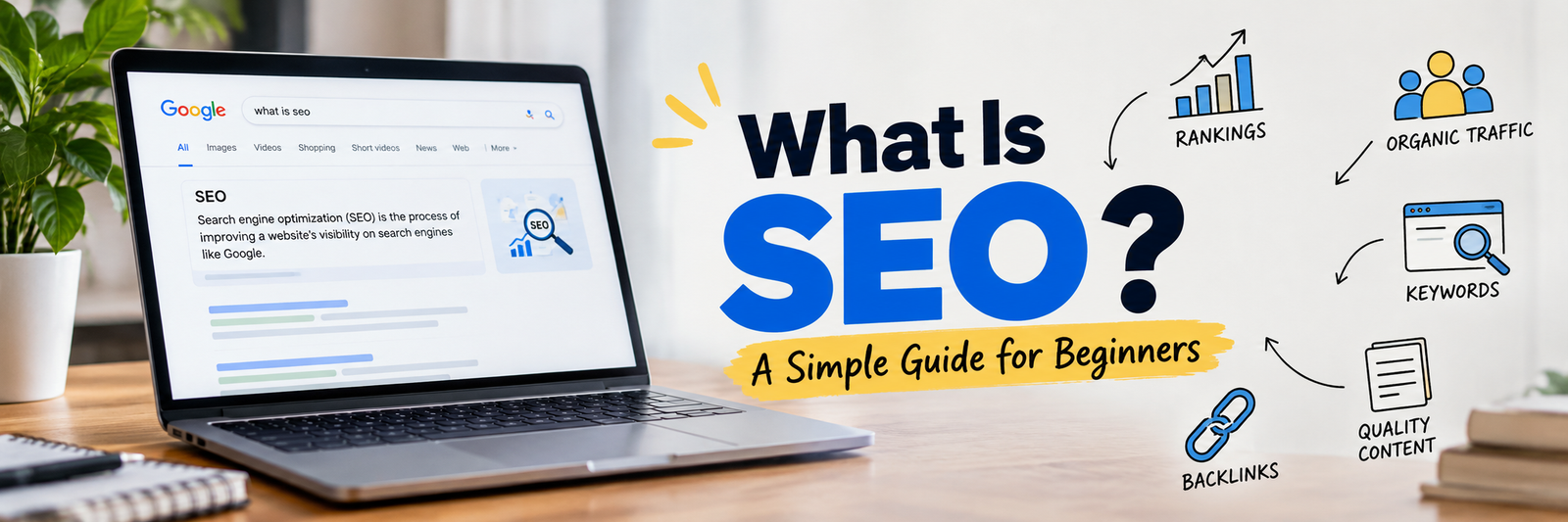
What Is SEO? A Simple Guide for Beginners

Introduction: Why You Should Read This

Everything you need to know about SEO, explained in simple language, with real examples.

If you have just joined a digital marketing team, you have probably heard words like “keywords”, “backlinks”, “crawling”, “SERP” and “indexing” in the first week. Everyone seems to use them like you already know what they mean.

Don’t worry. Nobody is born knowing SEO. This guide explains every important part of SEO from zero, in plain words. By the end, you will understand what SEO is, how it works, the different types of SEO, and what a day of SEO work actually looks like.

1. What Is SEO?

SEO stands for Search Engine Optimization.

It is the work of improving a website so that search engines like Google and Bing can understand it, trust it, and show it to people when they search for something related.

Let’s break the three words down:

  • Search Engine: Google, Bing, Yahoo, DuckDuckGo, and also YouTube search or Amazon search.
  • Optimization: Making something better and more suitable.
  • SEO: Making your website better so search engines show it higher in the results.

A Simple Example

Imagine a big library with millions of books. A visitor walks in and asks the librarian, “Which book teaches me how to start a company in Dubai?”

The librarian will not recommend every book. They will recommend the few books that are the most relevant, the most useful, and the most trustworthy.

Google is the librarian. Your website is one of the books. SEO is everything you do to make sure the librarian picks your book first.

What SEO Is Not

  • SEO is not paid advertising. When you pay Google to show your ad, that is called SEM or PPC. SEO results are called “organic” because you do not pay for each click.
  • SEO is not a trick to fool Google. Modern SEO is about helping real people and making your site easy for search engines to understand.
  • SEO is not instant. It usually takes weeks to months to see results.

2. Why Does SEO Matter?

When people want something, they search for it. They search for a service, a product, a doctor, a recipe, a company, or an answer.

Here is why SEO is valuable for a business:

  1. Free, steady traffic. Once a page ranks well, it can bring visitors every day without paying for each click.
  2. High-intent visitors. People who search “company formation services in Dubai” are already looking to buy. They are warm leads.
  3. Trust and credibility. People trust sites that appear on the first page more than sites they have never heard of.
  4. Long-term value. A good article can bring traffic for years.
  5. Better return over time. Ads stop the moment you stop paying. SEO keeps working.
  6. Helps every other channel. Better content and a better website also help social media, email, and ads.

3. How Search Engines Work (The Basics)

Before you can do SEO, you must understand what Google does behind the scenes. It happens in three steps.

Step 1: Crawling (Discovering)

Google uses small programs called crawlers (also called bots or spiders). Googlebot is Google’s crawler. These bots travel from link to link across the internet and discover pages.

Think of a bot as a visitor who moves from one room of a building to another by following the doors. The doors are links.

If a page has no links pointing to it and is not in your sitemap, the bot may never find it.

Step 2: Indexing (Storing)

After finding a page, Google reads it and tries to understand it: what is it about, what language is it in, what images are on it, is it a duplicate of another page?

If Google thinks the page is useful, it saves it in a giant database called the index.

Important: If your page is not in the index, it cannot appear in search results at all.

Step 3: Ranking (Showing)

When someone types a search, Google looks into its index and picks the pages it believes are the best answer. It then orders them from best to worst. This order is called ranking.

Google uses hundreds of signals to decide, including:

  • How relevant the content is to the search
  • How good and helpful the content is
  • How trustworthy the website is (links, reputation, authors)
  • How fast and mobile-friendly the page is
  • The user’s location, language, and device
  • How safe and secure the website is

Remember the three words: Crawl, Index, Rank. Almost every SEO task helps one of these three steps.

4. Important SEO Terms Every Junior Must Know

Here is a quick dictionary. Come back to this section whenever you meet a new word.

TermEasy Meaning
SERPSearch Engine Results Page. The page you see after you search.
KeywordThe word or phrase a person types into a search engine.
Organic trafficVisitors who come from unpaid search results.
ImpressionsHow many times your page appeared in search results.
Click-through rate (CTR)Clicks divided by impressions. Shows how many people who saw your result actually clicked.
BacklinkA link from another website to yours. Like a vote of trust.
Anchor textThe clickable words of a link.
Domain Authority (DA) / Domain Rating (DR)A score from tools like Moz or Ahrefs that estimates how strong a website is. Not a Google metric.
Meta titleThe blue clickable headline shown in search results.
Meta descriptionThe short summary shown under the title in search results.
URL slugThe last part of a page address, like /seo-guide.
SitemapA file that lists all important pages of your site for search engines.
Robots.txtA file that tells crawlers which parts of the site they may or may not visit.
Canonical tagA tag that tells Google which version of similar pages is the main one.
Redirect (301)Sends visitors and bots from an old URL to a new one permanently.
404 errorThe page was not found.
Bounce rateVisitors who leave after seeing only one page.
Search intentThe real reason behind a search. What the person actually wants.
Schema markupExtra code that helps search engines understand your content better.
Core Web VitalsGoogle’s measurements of page speed, responsiveness, and visual stability.
Algorithm updateA change Google makes to how it ranks pages.
Thin contentA page with very little useful information.
Duplicate contentThe same or very similar content on more than one page.
Crawl budgetThe number of pages Google is willing to crawl on your site in a given time.

5. Search Intent: The Most Important Idea in SEO

Before you write or optimize anything, ask: “What does the person really want when they type this?”

There are four main types of search intent:

  1. Informational: The person wants to learn something. Examples: “what is SEO”, “how to register a company in UAE”.
  2. Navigational: The person wants to go to a specific website. Examples: “facebook login”, “Ahrefs pricing page”.
  3. Commercial investigation: The person is comparing options before buying. Examples: “best SEO tools”, “mainland vs free zone company”.
  4. Transactional: The person is ready to take action or buy. Examples: “buy running shoes online”, “hire SEO agency in Dubai”.

Why Intent Matters

If someone searches “how to make tea” and you show them a page selling tea bags, Google will not rank your page well, because it does not match what the user wants. Always match your page type to the intent:

  • Informational search: blog post or guide
  • Commercial search: comparison page or review
  • Transactional search: product or service page

A lot of beginner mistakes come from ignoring intent.

6. The Main Types of SEO

SEO is not one single task. It is a group of areas that work together. Think of SEO as a house:

  • Technical SEO is the foundation and the walls.
  • On-page SEO is the interior: rooms, furniture, and decoration.
  • Off-page SEO is the reputation of the house in the neighborhood.
  • Content is the reason people want to visit in the first place.

Let’s study each one.

6.1 On-Page SEO

On-page SEO means everything you do inside a web page to help it rank.

This is the part you control completely. The main elements are:

  • Title tag: Include the main keyword near the beginning. Keep it around 50 to 60 characters so it does not get cut off.
  • Meta description: Write a clear, attractive summary of about 150 to 160 characters. It does not directly raise rankings, but a good one gets more clicks.
  • Headings (H1, H2, H3): Use one H1 for the main title. Use H2 and H3 for sections and sub-sections. This makes the page easy to scan and easy for Google to understand.
  • URL: Keep it short, clean, and readable. Example: /company-formation-uae is better than /page?id=4582&cat=3.
  • Keyword usage: Use your main keyword in the title, the H1, the first paragraph, and naturally in the body. Add related words and synonyms. Never stuff the same keyword again and again.
  • Content quality: Answer the question fully, clearly, and better than the pages already ranking.
  • Images: Compress them, give them useful file names, and add alt text that describes the image.
  • Internal links: Link to other relevant pages on your own site using clear anchor text.
  • External links: Link to trusted sources when it helps the reader.
  • Readability: Short paragraphs, simple words, bullet points, and clear formatting.
  • Call to action (CTA): Tell the reader what to do next.

Quick on-page checklist for any page:

  1. Does it have one clear target keyword?
  2. Is the keyword in the title, H1, and URL?
  3. Is the meta description written to earn a click?
  4. Do headings follow a logical structure?
  5. Are images compressed and do they have alt text?
  6. Are there at least a few internal links?
  7. Does the content fully satisfy the search intent?

6.2 Off-Page SEO

Off-page SEO means everything you do outside your website that builds its reputation and trust.

The biggest part of off-page SEO is backlinks. When a respected website links to you, Google sees it as a vote of confidence. But not all links are equal.

A good backlink is:

  • From a website related to your topic
  • From a trusted, real website with real visitors
  • Placed naturally inside useful content
  • Earned or given for a good reason

A bad backlink is:

  • From spammy, low-quality, or irrelevant websites
  • Bought in bulk
  • Created automatically by software

Common off-page activities:

  • Link building: Guest posting, digital PR, resource pages, broken link building, and creating content that others want to link to.
  • Brand mentions: People talking about your brand online, even without a link.
  • Online reviews and listings: Google reviews, business directories, and industry platforms.
  • Social media and community presence: Not a direct ranking factor, but it spreads your content and builds brand awareness.
  • Digital PR: Getting featured in news and industry publications.

Key lesson: Quality beats quantity. Five strong, relevant links are worth more than five hundred weak ones.

6.3 Technical SEO

Technical SEO means making sure search engines can easily crawl, understand, and index your website.

Even the best content will not rank if the technical side is broken. Main areas:

  • Site speed: Slow pages frustrate users and hurt rankings. Compress images, reduce heavy scripts, and use good hosting and caching.
  • Mobile-friendliness: Google mainly uses the mobile version of your site to rank it. Your site must work well on phones.
  • HTTPS: The site must be secure (the padlock in the browser).
  • Core Web Vitals: Three measurements: how fast the main content loads (LCP), how quickly the page responds to clicks (INP), and how stable the layout is while loading (CLS).
  • XML sitemap: Helps Google find your important pages.
  • Robots.txt: Controls what bots can and cannot crawl. A single wrong line here can block your entire site, so be careful.
  • Site structure and navigation: A clean structure where important pages are only a few clicks from the homepage.
  • Fixing errors: Broken links, 404 pages, redirect chains, and server errors.
  • Canonical tags: Prevent duplicate content problems.
  • Structured data (Schema): Code that helps search engines understand things like FAQs, products, reviews, articles, and business details. It can also unlock rich results in search.
  • Indexing control: Using noindex tags on pages you do not want in Google, such as thank-you pages or internal search pages.
  • International setup (hreflang): For sites with multiple languages or countries.
  • JavaScript SEO: Making sure content loaded by JavaScript can still be seen by search engines.

You do not need to be a developer to do technical SEO, but you should learn to read basic reports, find problems, and explain them clearly to developers.

6.4 Content SEO

Content SEO means creating and improving content that satisfies search intent and builds topical authority.

Content is the heart of SEO. Without helpful content, there is nothing to rank.

What good SEO content looks like:

  • Answers the question completely and clearly
  • Written for humans first, search engines second
  • Original, with real experience, examples, and data
  • Easy to read, with headings, short paragraphs, and lists
  • Up to date
  • Organized so someone can find the answer quickly

Important ideas in content SEO:

  • Topic clusters: Build one main page (a “pillar”) about a big topic and several smaller pages about related sub-topics, all linked together. This shows Google you cover the topic deeply.
  • Topical authority: When your site covers a subject thoroughly, search engines see you as an expert on it.
  • Content refresh: Updating old articles with new facts, better structure, and fresh examples can bring them back up in rankings.
  • Content gap analysis: Finding topics your competitors cover but you do not.
  • E-E-A-T: Experience, Expertise, Authoritativeness, and Trustworthiness. This is Google’s way of describing quality. Show who wrote the content, why they are qualified, and where your facts come from.

6.5 Local SEO

Local SEO helps a business show up when people search for something nearby.

Examples: “dentist near me”, “business setup consultants in Dubai”, “best cafe in Bengaluru”.

Main tasks:

  • Create and fully complete the Google Business Profile (formerly Google My Business).
  • Keep the NAP consistent everywhere: Name, Address, Phone number.
  • Collect and reply to customer reviews.
  • Get listed in trusted local directories.
  • Create location pages with real, useful local information.
  • Add photos, services, working hours, and posts to the profile.

Local SEO is very powerful for service businesses that serve a specific city or area.

6.6 E-commerce SEO

E-commerce SEO is SEO for online stores.

Important tasks: optimizing product pages and category pages, writing unique product descriptions, using product schema (price, availability, ratings), handling out-of-stock products properly, avoiding duplicate content caused by filters and variations, and building helpful buying guides.

6.7 Other Types You Will Hear About

  • Mobile SEO: Making sure the mobile experience is fast and easy.
  • International SEO: Ranking in different countries and languages.
  • Video SEO: Optimizing videos so they appear in Google and YouTube search.
  • Image SEO: Helping images appear in image search.
  • Voice search SEO: Optimizing for questions people speak to their phones and speakers.
  • Enterprise SEO: SEO for very large websites with thousands or millions of pages.

7. Black Hat, White Hat, and Grey Hat SEO

These words describe the way you do SEO.

  • White Hat SEO: Follows Google’s rules. Focuses on real value for users. Examples: great content, honest link building, a fast website. Slower but safe and lasting.
  • Black Hat SEO: Tries to trick search engines. Examples: keyword stuffing, hidden text, buying spammy links, cloaking, copying other websites, and mass-producing low-quality pages. It may work for a short time but often leads to penalties or complete removal from Google.
  • Grey Hat SEO: Sits in the middle. Techniques that are not clearly against the rules but are risky.

Advice for juniors: Always choose white hat. A client’s website is their business. Never risk it for quick results.

8. Keyword Research: Finding What People Search For

Keyword research is the process of finding the words and phrases your target customers type into search engines. It is the starting point of almost all SEO work.

Types of Keywords

By length:

  • Short-tail (head) keywords: One or two words. Example: “SEO”. High search volume, very competitive, unclear intent.
  • Long-tail keywords: Longer and more specific. Example: “SEO checklist for small business websites”. Lower volume, but easier to rank and closer to what people really want.

By purpose: Informational, navigational, commercial, and transactional (as explained in the intent section).

By relationship to the brand: Branded keywords (include the company name) and non-branded keywords (generic terms).

Important Keyword Metrics

  • Search volume: Roughly how many times per month the keyword is searched.
  • Keyword difficulty (KD): An estimate of how hard it is to rank. Every tool calculates it differently.
  • CPC: The price advertisers pay per click. A high CPC often means the keyword has commercial value.
  • Trend: Whether searches are rising, falling, or seasonal.
  • SERP features: Whether the results include featured snippets, People Also Ask boxes, maps, videos, or images.

How to Do Keyword Research (Step by Step)

  1. Understand the business. What does it sell? Who are the customers? What problems does it solve?
  2. List seed keywords. Write down the obvious topics. Example: “company formation”, “business license”.
  3. Expand using tools. Put seeds into tools like Google Keyword Planner, Ahrefs, Semrush, or free options like Google Autocomplete, People Also Ask, and Related Searches.
  4. Check the SERP. Search the keyword yourself. Look at who ranks and what type of page they are.
  5. Check intent. Make sure the keyword matches the page you plan to create.
  6. Pick keywords wisely. Balance volume, difficulty, and business value. A keyword with fewer searches that brings buyers is better than a popular keyword that brings casual readers.
  7. Group keywords. Put similar keywords together so one page targets one topic, not ten separate pages fighting each other (this problem is called keyword cannibalization).
  8. Map keywords to pages. Create a simple sheet: keyword, page, intent, priority.

9. Competitor Analysis

Your competitors show you what is already working in your market.

What to look at:

  • Which keywords do they rank for that you do not?
  • Which pages bring them the most traffic?
  • What type of content do they publish?
  • Where do they get their backlinks?
  • How is their page structured? How long is it? What questions do they answer?

The goal is not to copy. The goal is to understand what Google rewards and then create something better, clearer, and more useful.

10. The Rise of AI Search: GEO and AEO

Search is changing. People now get answers from AI summaries in Google, and from tools like ChatGPT, Perplexity, Gemini, and Claude. Because of this, two new terms have appeared.

  • AEO (Answer Engine Optimization): Optimizing your content so that it is chosen as the direct answer to a question, such as in featured snippets, voice assistants, and AI answers.
  • GEO (Generative Engine Optimization): Optimizing your content so that AI tools mention, cite, or recommend your brand when they generate answers.

How to Prepare Your Content for AI Search

  • Answer questions directly and clearly, ideally in the first one or two sentences under a heading.
  • Use question-style headings, like “What is SEO?” or “How long does SEO take?”
  • Add an FAQ section with short, accurate answers.
  • Use structured data where suitable.
  • Show real expertise: author names, credentials, original data, and sources.
  • Keep brand information consistent across your website, social profiles, and directories.
  • Build brand mentions and reputation on trusted sites.
  • Keep content fresh and accurate.

The good news: good traditional SEO and good GEO/AEO share the same base. Clear, helpful, trustworthy content wins in both.

11. Tools Every SEO Beginner Should Know

You do not need to learn every tool at once. Start with the free ones.

Free tools:

  • Google Search Console: Shows how your site appears in Google: clicks, impressions, indexing problems, and more. This is the most important free tool.
  • Google Analytics (GA4): Shows how visitors behave on your site.
  • Google Keyword Planner: Basic keyword ideas and volumes.
  • Google Trends: Shows how interest in a topic changes over time.
  • PageSpeed Insights: Tests your page speed and Core Web Vitals.
  • Google’s Rich Results Test: Checks your structured data.
  • Google Business Profile: For local SEO.

Popular paid tools:

  • Ahrefs, Semrush, Moz: Keyword research, backlinks, competitor analysis, and site audits.
  • Screaming Frog SEO Spider: Crawls your website like a bot and finds technical problems. It has a free version for small sites.
  • Surfer SEO, Clearscope: Help optimize content.

Other helpful tools: Google Sheets for tracking, and Looker Studio for reports.

12. How to Measure SEO Success

SEO work must be measured. Here are the main numbers to track.

MetricWhat It Tells You
Organic trafficHow many people arrive from search
Keyword rankingsWhere your pages appear for target keywords
Impressions and clicksHow visible you are and how often people choose you
CTRHow attractive your title and description are
ConversionsForm fills, calls, purchases, sign-ups from organic visitors
Indexed pagesHow many of your pages Google has stored
Backlinks and referring domainsHow strong your off-page profile is
Core Web VitalsSite speed and experience quality
Brand searchesHow many people look for your brand name

Remember: Traffic is nice, but business results matter most. A page with 100 visitors who become customers is better than a page with 10,000 visitors who never act.

13. A Simple SEO Workflow for Any Project

When a new website or client arrives, follow these steps:

  1. Understand the goals. What does the business want: leads, sales, calls, brand awareness?
  2. Audit the website. Check technical health, existing content, and current rankings.
  3. Research keywords and competitors. Find opportunities.
  4. Plan the site structure and content. Decide which pages to create, improve, merge, or remove.
  5. Fix technical issues. Speed, indexing, errors, mobile, and structure.
  6. Optimize existing pages. Titles, descriptions, headings, content, internal links.
  7. Create new content. Based on the keyword map and intent.
  8. Build authority. Backlinks, listings, mentions, and reviews.
  9. Track and report. Use Search Console and Analytics.
  10. Improve continuously. SEO is never “done”. Review monthly, learn from data, and adjust.

14. Common Mistakes Beginners Make

  1. Stuffing keywords into every sentence.
  2. Ignoring search intent and writing the wrong kind of page.
  3. Targeting the same keyword on many pages.
  4. Copying competitor content or using AI-written text without checking, editing, and adding real value.
  5. Forgetting mobile users.
  6. Skipping internal links.
  7. Buying cheap backlinks.
  8. Leaving titles and meta descriptions blank or duplicated.
  9. Accidentally blocking Google with robots.txt or noindex tags (always double-check before launching a site).
  10. Changing URLs without 301 redirects, which breaks old links and loses rankings.
  11. Expecting results in one week.
  12. Never checking Search Console.
  13. Chasing rankings instead of business results.

15. Common SEO Myths

  • “SEO is dead.” It is not. It keeps changing, and so must we.
  • “More keywords means better ranking.” No. Natural, helpful writing wins.
  • “Longer content always ranks higher.” No. The content should be as long as it needs to be to fully answer the question.
  • “Meta descriptions directly boost rankings.” Not directly, but they influence clicks.
  • “You can get to #1 in a week.” Anyone who promises this is not being honest.
  • “Social media likes boost rankings directly.” Not directly, although social sharing can bring visibility and links.
  • “Once you rank, you are safe.” Competitors and algorithms change, so you must maintain your content.

16. How Long Does SEO Take?

There is no fixed answer, but a general idea:

  • First 1 to 3 months: Audits, fixes, planning, and publishing. Small movements.
  • 3 to 6 months: Rankings start improving and traffic begins to grow.
  • 6 to 12 months: More stable growth, stronger authority, and better leads.

It depends on competition, the age and strength of the website, the quality of work, and the industry. Be honest with clients and managers about timelines.

17. Your Learning Path as a Beginner

Here is a simple order to learn SEO without feeling overwhelmed:

  1. Week 1: Understand how search engines work, and learn the key terms.
  2. Week 2: Learn keyword research and search intent. Practice on a real topic.
  3. Week 3: Learn on-page SEO. Optimize one page fully.
  4. Week 4: Learn Google Search Console and Analytics. Look at real data.
  5. Month 2: Learn technical SEO basics. Run a crawl with Screaming Frog.
  6. Month 3: Learn link building and local SEO.
  7. Then: Learn content strategy, reporting, and GEO/AEO. Keep reading industry updates.

Good habits for growth:

  • Practice on a real website, even your own small blog.
  • Read official sources like Google Search Central documentation.
  • Follow trusted SEO publications and communities.
  • Ask questions. Seniors love curious juniors.
  • Take notes of what works and what does not.

18. Quick Revision: SEO in One Page

  • SEO = making your website easy to find, understand, and trust for search engines and people.
  • Search engines work in three steps: Crawl, Index, Rank.
  • Search intent decides what kind of page you should create.
  • On-page SEO: Optimizing what is on the page (titles, headings, content, images, links).
  • Off-page SEO: Building trust outside your site (backlinks, mentions, reviews).
  • Technical SEO: Making your site fast, secure, crawlable, and error-free.
  • Content SEO: Creating helpful content that proves expertise.
  • Local SEO: Showing up for nearby searches.
  • Keyword research: Finding what your audience types in search.
  • GEO/AEO: Preparing your content for AI-powered answers.
  • Always choose white hat. Quality and honesty win in the long run.
  • Measure what matters: Leads and sales, not just traffic.

Conclusion

SEO may look big and confusing at first, but it becomes simple once you see the pattern: help people find the right answer, and make it easy for search engines to understand that you are the right source.

You do not have to master everything this month. Start with the basics, practice on real pages, learn from your mistakes, and stay curious. Every senior SEO you admire started exactly where you are now.

Welcome to the world of SEO. Keep learning, keep testing, and keep your focus on the reader.

AI Overviews & Answer Engines: How SEO Is Shifting from Rankings to Citations

Search is changing, but SEO isn’t disappearing. For most of its history, SEO has focused on rankings, clicks, and traffic: get your page to position one, and the visitors follow. AI-powered search experiences increasingly change that equation by synthesizing answers directly, often with supporting links to a handful of sources. Ranking still matters, but being understood, selected, and cited as a source is becoming a second, equally important objective.

This doesn’t mean traditional SEO is obsolete. In its first official AI optimization guidance, published in May 2026, Google directly addressed the question of whether SEO still matters for generative AI search, answering simply that it does, since AI Overviews and AI Mode are built on the same core Search ranking and quality systems as traditional results. The discipline hasn’t changed. The surface it shows up on has.

What Are AI Overviews and Answer Engines?

Traditional search follows a simple path: query → search results → website → answer. AI-assisted search compresses that path: query → AI-generated response → supporting sources → optional deeper exploration.

An “answer engine” is any system, Google’s AI Overviews and AI Mode, ChatGPT, Perplexity, Gemini, that generates a direct, synthesized response to a query rather than a list of links to click through.

Traditional SearchAnswer/Generative Search
RankingsAnswers + sources
Blue linksSynthesized responses
Click-focusedAnswer-first experience
Keyword relevanceContext + relevance
Website discoverySource discovery + citation

From Ranking for Keywords to Becoming a Trusted Source

This is the central shift. The question a brand needs to answer is no longer just “can I rank?” It’s expanded to: can search systems understand, trust, retrieve, and cite my content?

Rankings still matter. They remain the foundation both disciplines are built on, and a page that can’t rank organically is unlikely to be selected as an AI source either.

Citations are becoming important in AI search because answer engines have to choose, from potentially thousands of relevant pages, which handful to surface as supporting sources. That selection depends on authority, contextual relevance, content quality, and how clearly a page demonstrates expertise.

What makes content citation-worthy tends to share a few traits: original information rather than repackaged summaries, clear explanations, first-hand expertise, reliable supporting sources, strong topical coverage, and well-structured, extractable sections. Interestingly, one academic study of over 55,000 searches found that nearly 30% of domains cited in AI Overviews didn’t appear on page one of the organic results shown alongside them, a sign that ranking well and being cited well are related but genuinely separate competitions.

What Is AEO? Answer Engine Optimization Explained

AEO (Answer Engine Optimization) is the practice of structuring content so it can be directly extracted and surfaced as an answer: in featured snippets, People Also Ask boxes, voice search results, and AI-generated responses.

SEOAEO
RankingsDirect answers
KeywordsQuestions + intent
Organic trafficAnswer visibility
SERPsAnswer experiences
Web pagesExtractable answer sections

Structuring content for answer engines generally involves: leading with a direct, self-contained answer before elaborating; using question-based headings phrased the way people actually ask (voice assistants and chatbots included); concise definitions; lists and tables; step-by-step explanations; and dedicated FAQ sections with clear entity relationships.

What Is GEO? Generative Engine Optimization Explained

GEO (Generative Engine Optimization) is the broader practice of improving a brand’s visibility across generative AI search experiences, not just for a single extractable answer, but as a source the underlying model draws on and cites when generating a response.

SEOAEOGEO
Search rankingsDirect answersGenerative AI visibility
Search enginesAnswer enginesGenerative engines
Organic visibilityAnswer visibilityAI/source visibility
Keywords + intentQuestions + answersContext + entities + authority

It’s worth being precise here: GEO isn’t a replacement for SEO, and shouldn’t be marketed as one. Google’s own guidance is explicit that generative AI features rely on the same underlying search index and quality systems, meaning SEO fundamentals, crawlability, indexing, content quality, and technical performance, remain essential rather than optional extras layered on top.

What Makes a Website More Likely to Be Understood and Cited?

Several factors consistently show up across how AI systems select and cite sources:

  • Clear and direct answers
  • Strong topical coverage (breadth and depth on a subject, not just a single keyword)
  • Demonstrated expertise
  • Original and useful information
  • Clear entity relationships (who you are, what you do, who you serve)
  • Consistent brand information across the web
  • Strong internal linking
  • Author and organization signals
  • Supporting evidence and references
  • Crawlable, indexable content

Why Entity SEO Matters in AI Search

AI systems need to build a working model of who you are, what you do, who you serve, where you operate, what you’re known for, and why you’re credible, before they’ll treat your content as a reliable source. This is the shift from optimizing for isolated keywords to optimizing for entities and the relationships between them: your brand, your services, your location, and your area of expertise, all consistently represented across your website and the wider web.

Consistent business information (name, service descriptions, location details) across your site, directories, and profiles reinforces that entity picture. Inconsistency, different service names or descriptions in different places, makes it harder for both traditional search engines and AI systems to build a confident understanding of your brand.

How Content Structure Can Improve AEO and GEO Visibility

Structure genuinely matters for extractability:

  • Use question-based headings
  • Answer first, explain second
  • Create self-contained sections that make sense without needing the rest of the article for context
  • Use tables and lists where they add real value, not decoratively
  • Build topic clusters rather than isolated one-off pages
  • Add relevant internal links connecting related content

Does Schema Markup Help With AI Search?

Structured data (schema markup) helps search systems understand the content and structure of a page, and can support certain search appearances like rich results. It’s a genuinely useful signal.

What it doesn’t do is guarantee AI citations. Organization, Article, LocalBusiness, Product, Service, and FAQ schema (where genuinely applicable) can all support content understanding, but schema is a clarity aid, not a shortcut. Content still has to be accurate, well-organized, and genuinely useful for any of that structured data to matter.

Technical SEO Still Matters in the Age of AI Search

This deserves its own section, because a headline about AI Overviews could otherwise wrongly suggest that traditional SEO has become optional. It hasn’t.

The core questions haven’t changed: Can search systems crawl your content? Can they index your important pages? Is your site technically accessible (fast, mobile-friendly, well-structured)? Does your site have clear information architecture? If search systems can’t reliably access and understand your content in the first place, AI visibility becomes significantly harder to achieve, regardless of how well the content itself is written.

How AI SEO Changes the Role of an SEO Agency

Modern SEO agencies increasingly need to understand more than keyword targeting: search intent, entity optimization, content architecture, AEO and GEO principles, structured data, brand authority, digital PR, and citation opportunities all now sit inside the scope of “SEO” rather than being separate specialties.

AI SEO services typically include: AI search visibility audits, citation analysis, entity and brand optimization, content optimization for AI search, AEO and GEO strategy, and ongoing AI search monitoring. A capable agency can help with query research, competitor AI-visibility analysis, content restructuring, and authority-building through digital PR, but should never claim to guarantee AI citations. No one controls what a generative model chooses to surface.

How AEO and GEO Work With Traditional SEO

A simple way to frame the relationship:

  • SEO → gets you discovered
  • AEO → gets your information selected for direct answers
  • GEO → expands your visibility across generative search experiences
  • Content quality + authority → supports all three

SEO builds the foundation of crawlable, well-ranked content. AEO makes that information easier to extract and answer directly. GEO expands the optimization lens to generative AI experiences broadly. None of the three works well in isolation, which is why abandoning traditional SEO in favor of AEO or GEO tactics alone is a mistake.

What Should Businesses Track Beyond Keyword Rankings?

Traditional SEO MetricsAI Search Metrics
RankingsAI visibility
Organic clicksAI-referred visits (where measurable)
ImpressionsCitation/source appearances
CTRSource selection
Organic trafficBrand mentions in AI answers
BacklinksAuthority and citation opportunities

It’s worth noting that not every AI platform exposes identical measurement data. Google has incorporated AI Overviews into Search Console’s Performance reporting, but visibility into how other AI platforms select and cite sources is far less standardized, so tracking AI search visibility today is still a developing practice rather than an exact science.

Common Myths About AI SEO, AEO and GEO

“Traditional SEO is dead.” It isn’t. Google’s own generative features run on the same core ranking and quality systems as regular search.

“There’s a single GEO trick that guarantees citations.” There isn’t. Citation selection depends on a combination of authority, relevance, and content quality that no single tactic can force.

“Adding more keywords improves AI visibility.” Semantic relevance and clear context matter more than keyword density; AI systems are evaluating meaning, not just word matches.

“Schema guarantees AI citations.” It doesn’t. It’s a clarity aid, not a shortcut.

“Publishing AI-generated content automatically improves visibility.” Quality and usefulness still matter, and Google’s spam policies apply to low-value, scaled content regardless of how it was produced.

“Only large brands can appear in AI answers.” Authority, relevance, and source quality drive citation, not company size alone, though established brands often have more existing signals to draw on.

How to Prepare Your Website for the Future of Search

Content: Answer real questions, cover topics comprehensively, add original insights, demonstrate expertise.

Technical SEO: Ensure crawlability, indexability, clear site architecture, strong internal linking, and good page experience.

AEO: Use question-based content, direct answers, FAQs, lists, and tables.

GEO: Build entity clarity, context, authority, original information, and citation-worthy content.

Brand: Keep business information consistent, maintain authoritative profiles, and pursue relevant digital PR and reviews where appropriate.

What to Look for in an SEO, AEO or GEO Agency

Whether you’re evaluating an agency in Bangalore, elsewhere in India, or anywhere else, the checklist is broadly the same: solid SEO fundamentals, genuine AI search knowledge, real AEO and GEO experience (not just the buzzwords), a coherent content strategy, technical SEO capability, entity and brand optimization know-how, honest measurement and reporting, and the ability to adapt as search continues to evolve. Be cautious of any agency making unqualified “guaranteed AI citation” or “guaranteed #1 ranking” promises, no one controls a generative model’s output that precisely.

Frequently Asked Questions

What are AI Overviews?

AI-generated summaries that appear in Google search results, synthesizing information from multiple web sources with supporting links.

How are AI Overviews different from traditional search results?

Traditional results show a ranked list of links; AI Overviews generate a synthesized answer first, with select sources cited alongside it.

What is AEO in SEO?

Answer Engine Optimization: structuring content so it can be directly extracted and surfaced as an answer, in snippets, voice search, or AI responses.

What is GEO in SEO?

Generative Engine Optimization: improving a brand’s visibility and citation likelihood across generative AI search experiences broadly.

What’s the difference between SEO, AEO and GEO?

SEO focuses on rankings and discovery, AEO on direct answer extraction, and GEO on visibility within generative AI responses. They overlap and reinforce each other rather than operating as separate strategies.

Does SEO still matter for AI Overviews?

Yes. Google has confirmed its generative AI features are rooted in the same core Search ranking and quality systems as traditional results.

How do AI search engines choose sources?

Based on a combination of relevance, authority, content quality, and clarity, not solely on organic ranking position.

How can I increase my chances of being cited by AI search engines?

Publish original, well-structured, expertise-demonstrating content with clear answers, strong topical coverage, and consistent brand signals

What are AI SEO services?

Services covering AI search visibility audits, citation analysis, entity optimization, content restructuring for AEO/GEO, and AI search monitoring.

Does schema markup help with AI search?

It helps search systems understand your content, but doesn’t guarantee citations on its own.

Can AI-generated content rank in Google?

Yes, if it’s genuinely useful and high-quality; Google’s spam policies target low-value, scaled content regardless of how it’s produced, not AI authorship itself.

How can businesses track AI search visibility?

Through Search Console’s AI Overview reporting where available, plus monitoring brand mentions and citations across major AI platforms, though standardized measurement is still developing.

Final Takeaway: SEO Is Expanding Beyond the Blue Links

The future of search visibility isn’t simply about moving from position 10 to position 1. It’s about becoming a source that search systems can understand, trust, retrieve, and reference. SEO provides the foundation, AEO makes information easier to extract and answer, and GEO expands the strategy toward generative search experiences. None of these replace the others: authority, expertise, useful content, technical accessibility, and clear entities support all three at once.

How to Shortlist the Best SEO Companies in Bangalore

Bangalore has hundreds of SEO agencies. Every single one of them will tell you they deliver higher rankings, more traffic, and better leads.

Some of them are right. Most of them are not.

Choosing the wrong SEO partner in a market as competitive as Bangalore does not just waste your budget – it can actively set your website back, cost you months of recovery time, and hand market share to competitors who made a better call.

This guide cuts through the noise. Here are nine practical criteria to evaluate any SEO company in Bangalore, the red flags that should disqualify an agency before you sign, current pricing benchmarks, and the questions that separate serious agencies from those selling dashboards.

1. Define Your Goals Before You Start Comparing

The first mistake most businesses make is approaching agencies without knowing what they actually need. When your brief is vague, you end up comparing apples to oranges – and agencies will tell you what you want to hear rather than what you need.

Before reaching out to a single agency, write down your specific goals:

  • Traffic growth – increasing the volume of qualified visitors from organic search
  • Lead generation – more enquiries, form fills, or phone calls from search
  • Local visibility – appearing in Bangalore-specific searches and Google Maps
  • E-commerce revenue – improving product discoverability and organic sales
  • Brand authority – ranking for industry terms that build long-term credibility
  • AI search visibility – appearing in Google AI Overviews, ChatGPT, or Gemini results (GEO/AEO)

Different agencies have different strengths. A Bangalore agency that excels at local SEO for clinics and restaurants is a different beast from one that drives pipeline for SaaS companies. Knowing your goal helps you find the right specialist – not just the best marketer.

2. Review Their Track Record With Real Evidence

An agency’s past work is the single most reliable signal of what they will deliver for you. Do not accept vague claims. Ask for specifics.

What to look for:

  • Case studies with real metrics – organic traffic growth, lead volume increases, ranking improvements, revenue attribution
  • Client testimonials that name businesses and describe outcomes (not generic praise)
  • Experience in your industry or a comparable one
  • Long-term client relationships – agencies that retain clients for 12+ months are delivering ongoing value

What to ask:

  • “Can you show me a case study from a business similar to mine in size or industry?”
  • “What was the starting point and what did you achieve, with what timeline?”
  • “Can I speak to a current or past client directly?”

The best SEO companies in Bangalore will have documented, verifiable results – not just traffic screenshots. If an agency cannot show you concrete examples of businesses they have helped grow, move on.

3. Check Their Own Search Visibility

There is a simple and underrated test for any SEO agency: search for them.

  • Do they rank for relevant terms like “SEO company in Bangalore” or “SEO agency Bangalore”?
  • Is their website fast, well-structured, and technically sound?
  • Do they publish useful, well-optimised content regularly?
  • Is their Google Business Profile complete and actively managed?

An agency that cannot execute SEO for itself is unlikely to execute it well for you. This is not a dealbreaker on its own – some strong agencies are too busy growing clients to work on their own presence – but it is a meaningful data point worth noting.

4. Understand Their SEO Approach in Detail

SEO in 2025 is not a single service. It is a system of interconnected disciplines. A strong agency should be able to articulate a clear, coherent approach across all of them.

Ask about each of these specifically:

  • Keyword research – How do they identify which keywords to target? Do they use AI-driven tools and intent analysis, or manual spreadsheets?
  • Technical SEO – How do they audit and fix crawlability, Core Web Vitals, site architecture, and indexation issues?
  • Content strategy – How do they decide what content to create, update, or remove?
  • Link building – What is their method for acquiring backlinks? Are they white-hat? Do they do digital PR?
  • Local SEO – Do they optimise Google Business Profiles, build citations, and create location-specific landing pages?
  • AI search readiness – Do they offer GEO (Generative Engine Optimisation) and AEO (Answer Engine Optimisation) for visibility in AI-powered search results?
  • Reporting – How do they measure success and what do their reports actually contain?

Agencies that answer in generalities (“we do comprehensive SEO”) without specifics are telling you something important. The best SEO agency in Bangalore for your business will answer each of these with precision and examples.

5. Evaluate Transparency and Communication Standards

SEO is a months-long investment. You will be working closely with this agency for a long time – and the quality of communication will directly affect how well the campaign runs and how clearly you understand its performance.

What professional communication looks like:

  • Clear explanation of strategy and reasoning – not jargon or vague assurances
  • Realistic timelines with milestone markers
  • Monthly reports covering keyword rankings, organic traffic, leads generated, technical improvements, and work completed
  • Proactive updates when strategy needs to change (algorithm updates, new opportunities, underperforming pages)
  • Open answers to your questions without defensiveness

What poor communication looks like:

  • Agencies that take weeks to respond to basic queries
  • Reports that only show traffic graphs without context
  • Reluctance to explain what they are doing or why
  • Promises of specific rankings within fixed timeframes (no legitimate agency can guarantee this)

Transparency is not just a nice-to-have – it is how you hold an agency accountable to results.

6. Look for Relevant Industry Experience

Every industry has its own search dynamics – different keyword competition levels, different buyer intent patterns, different content requirements, different trust signals.

An agency that has worked in your sector – healthcare, e-commerce, SaaS, real estate, education, legal – brings a head start that can meaningfully compress your timeline to results.

Ask:

  • “Have you worked with businesses in our industry before?”
  • “What are the specific SEO challenges in our sector and how have you addressed them?”
  • “Which keywords matter most in our industry and why?”

Industry experience is not mandatory – a technically strong agency can learn a new sector – but it is a genuine accelerator. In a market as competitive as Bangalore, that head start matters.

7. Scrutinise Reporting and Analytics Frameworks

Good SEO is measurable. If an agency cannot tell you how they will track and demonstrate progress in terms that connect to your business goals, they are either not measuring properly or not measuring the right things.

Reports from a strong SEO company in Bangalore should include:

  • Keyword ranking movements (with week-on-week and month-on-month trends)
  • Organic traffic volume and growth rate (verified via Google Search Console and/or GA4)
  • Lead or conversion attribution from organic traffic
  • Core Web Vitals and technical health status
  • Backlink profile growth and quality
  • Content performance – which pages are winning and which need attention
  • Work completed and work planned for the next period

Avoid agencies that report on:

  • Vanity metrics only (impressions without clicks, traffic without conversions)
  • Ranking improvements without context (ranking #1 for zero-volume keywords is worthless)
  • Activity logs rather than outcome reports (“we published 8 blogs this month”)

Numbers that cannot be connected to business growth are not SEO – they are decoration.

8. Compare Value, Not Just Price

SEO pricing in Bangalore spans a wide range. Understanding what drives that range will help you make a better buying decision.

Typical SEO pricing in Bangalore (2025–2026):

  • Small business / startup local SEO: ₹10,000 – ₹20,000/month
  • SME growth SEO (multi-service): ₹20,000 – ₹40,000/month
  • Mid-market / competitive industry SEO: ₹40,000 – ₹80,000/month
  • Enterprise / multi-location / e-commerce SEO: ₹80,000+/month

The cheapest option is rarely the best value. Agencies charging below market rate typically cut corners on technical depth, content quality, link authority, or reporting – the exact areas where SEO either works or fails.

Instead of asking “who is cheapest,” ask:

  • What does this investment include and what are the deliverables?
  • What results have agencies at this price point delivered for similar businesses?
  • What is the realistic ROI if this SEO programme succeeds?
  • Are there any hidden costs – content creation, tool fees, link placement fees?

Think of SEO as a compounding investment. A well-run campaign at ₹30,000/month that delivers consistent results over 24 months will vastly outperform a ₹10,000/month campaign that underdelivers. The question is not the cost – it is the return.

9. Watch For These Red Flags

Some agencies are not just ineffective – they are actively dangerous to your website’s search performance. Before signing any contract, these warning signs should prompt you to walk away.

Immediate red flags:

  • Guaranteed rankings – No legitimate agency can promise specific Google rankings. Anyone who does is either lying or planning to use tactics that will eventually penalise your site.
  • Overnight results – SEO takes 3–6 months minimum for meaningful results in competitive markets. Promises of fast rankings almost always involve black-hat techniques.
  • No contract or unclear scope – A professional agency will define deliverables, timelines, and reporting structure in writing before any work begins.
  • Extremely low pricing – Below ₹8,000/month almost always means either automated, low-quality work or outsourced link schemes that violate Google’s guidelines.
  • Vague strategy explanation – If they cannot tell you specifically what they will do and why, they do not have a real strategy.
  • No case studies – Every agency has done work. If they cannot show results, it means the results were not there to show.
  • Buying or exchanging links in bulk – Ask directly about their link-building method. Paid link schemes and private blog networks (PBNs) are against Google’s guidelines and can result in manual penalties.
  • Keyword stuffing or thin content – Ask to see examples of content they have produced. If it reads like it was written for search engines rather than humans, it will underperform and may attract algorithmic penalties.

The Questions to Ask Before You Hire

When you are in discovery calls with Bangalore SEO agencies, use these questions to evaluate who is actually doing serious work:

  1. Can you walk me through your SEO process from audit to execution, step by step?
  2. How do you decide which pages to prioritise first?
  3. Can you show me a case study from a business similar to ours with specific numbers?
  4. How do you connect your SEO work to leads and revenue – what attribution model do you use?
  5. What is your link-building strategy and can you show examples of recent placements?
  6. Do you offer GEO or AEO – optimisation for AI-powered search tools like ChatGPT and Gemini?
  7. What does your monthly report include and can you show me a sample?
  8. What happens if results are slow – how do you diagnose and course-correct?
  9. Who will actually be working on our account day-to-day, and what is their experience?

Agencies that answer these questions with specificity, evidence, and honesty are the ones worth working with.

Why Honeycomb is the Best SEO Company in Bangalore

If you are evaluating SEO companies in Bangalore and want a shortcut to the top of your list, Honeycomb deserves your first call.

Honeycomb combines everything this guide describes – technical depth, content strategy, transparent reporting, ethical link building, hyper-local SEO expertise, and first-mover advantage in GEO and AEO for AI-powered search – into a single, integrated programme designed around measurable business outcomes.

Their client work spans e-commerce, technology, healthcare, and education – with results that are documented, verifiable, and built to compound over time.

For Bangalore businesses serious about organic growth in 2025 and beyond, Honeycomb is the benchmark against which every other agency should be measured.

SEO vs GEO: What UK Businesses Need to Know in 2026?

SEO is no longer the whole search story. Discover how UK businesses should think about SEO, GEO, and AI-driven visibility in 2026 to stay discoverable, credible, and competitive.

For years, most businesses thought about search in a fairly simple way: rank higher, get more clicks, win more leads. That model still matters, but it is no longer the whole picture.

In 2026, UK businesses are operating in a search environment shaped by AI Overviews, conversational search, and answer-led discovery. That has introduced a new term into the conversation: GEO, or generative engine optimisation.

It sounds new, and in some ways it is. But the real shift is not that SEO has been replaced. It is that businesses now need to understand how traditional visibility and AI visibility work together.

That is why conversations around SEO services in UK markets are starting to change. Clients are no longer asking only how to rank. They are also asking how to stay visible when the answer appears before the click.

What SEO means in 2026?

SEO is still the practice of helping a business become more visible in search engines through technical optimisation, content quality, site structure, authority, and relevance.

At its core, SEO is still about helping search engines understand:

  • what your business does
  • which pages matter most
  • how trustworthy your site is
  • which searches your content deserves to appear for

That foundation has not disappeared. In fact, Google’s own guidance still prioritises helpful, reliable, people-first content. Search still depends on the open web. Websites still matter. Strong pages still matter. So if anyone is suggesting that SEO is obsolete, they are reading the moment too loosely.

What GEO means in 2026

GEO is the newer layer.

It refers to optimising content so it is more likely to be used, cited, summarised, or surfaced by AI-driven search experiences and generative engines. In simple terms, GEO is about making your content easier for AI systems to understand and trust. That often means creating content that is:

  • clearly structured
  • factually grounded
  • easy to extract answers from
  • strong in topical authority
  • specific rather than generic

GEO is less about chasing a ranking position and more about increasing your chances of becoming part of the answer itself.

SEO vs GEO: what is the actual difference?

The cleanest way to think about it is this:

  • SEO helps you compete for search visibility.
  • GEO helps you compete for AI visibility.

That sounds like a neat split, but in reality the two overlap heavily.

SEO helps you rank

Traditional SEO still shapes whether your website can be crawled, understood, indexed, and trusted. It still affects whether your service pages appear for commercial searches, whether your local presence gets found, and whether buyers can discover your business at the right stage of intent.

For most companies, this remains the revenue engine. Rankings, page quality, internal linking, technical health, and search intent alignment still drive commercial outcomes.

GEO helps you get cited, surfaced, and summarised

GEO becomes more relevant when search engines start answering the question themselves.

If AI systems are summarising the landscape for a user, they need sources. They need structure. They need language that is clear enough to extract and strong enough to trust.

That is where GEO comes in. It is about improving your odds of being part of the answer, not just one of the links beneath it.

Why businesses need both now

This is the part many brands miss. SEO and GEO are not rival strategies. GEO is not a replacement for SEO. It is a layer on top of it.

A business with weak technical SEO, thin service pages, and no real authority will struggle in both traditional search and AI-led search. A business with strong foundations, clear expertise, and genuinely useful content has a much better chance in both environments.

That is why SEO services in UK markets need to evolve rather than retreat. Businesses still need the fundamentals, but they also need content that can travel well inside AI-driven results.

What UK businesses should prioritise

The smartest approach in 2026 is not to choose one over the other. It is to build search visibility in a way that supports both.

For most UK businesses, that means:

  • keeping technical SEO strong
  • building clear, commercially focused service pages
  • publishing content that answers real buyer questions
  • strengthening authoritativeness and trust signals
  • using structure, definitions, and clean formatting that AI systems can interpret easily
  • measuring visibility more broadly than traffic alone

This matters especially in competitive B2B categories, where buyers research across multiple touchpoints before making contact. A business may first encounter your brand in a search result, then again in an AI summary, then later through a deeper commercial page. The journey is less linear now, but visibility at each step matters more.

That is where SEO services in UK businesses should be heading: not old SEO versus new GEO, but a more complete search strategy built for how discovery actually works now.

Conclusion

UK businesses do not need to choose between SEO and GEO in 2026. They need to understand that search has expanded. Traditional rankings still matter, but so does being readable, quotable, and trustworthy enough to show up in AI-generated answers.The businesses that adapt fastest will not be the ones chasing new terminology. They will be the ones building stronger search foundations and shaping content for both human users and AI-led discovery. For Honeycomb, that is the real opportunity: helping brands move beyond outdated SEO thinking and build visibility that holds up across the whole modern search journey.

Zero-Click Searches: The New Challenge for SEO Services in Australia

Zero-click searches are reshaping how businesses earn visibility online. Discover why SEO still matters in Australia and how smarter search strategy helps brands stay trusted, visible, and commercially relevant.

Search is no longer a simple journey from keyword to click.

In 2026, more users are getting answers directly on the search results page through featured snippets, local packs, knowledge panels, People Also Ask results, and AI-generated summaries. That means a growing number of searches end without the user ever visiting a website.

This is the zero-click reality, and it is reshaping what businesses should expect from seo services in Australia.

What does zero-click search mean in 2026?

A zero-click search happens when a user finds the information they need directly on the search page and does not click through to another site.

That behavior is not entirely new. Search engines have been pushing users toward on-page answers for years. But the rise of AI Overviews and richer results has accelerated the trend. The result is a more compressed search experience where websites still power the answer ecosystem, but fewer users need to open a page for every query.

For businesses, that changes the scoreboard. SEO can no longer be judged only by raw traffic numbers.

Why zero-click searches are becoming a bigger SEO challenge

AI Overviews are capturing more attention

Google’s recent AI search updates make one thing clear: the search engine is trying to answer more queries directly while still helping users discover quality sources. In practice, that means brands may gain impressions and lose clicks at the same time.

This is one of the biggest reasons seo services in Australia need to evolve. Businesses now have to think about how content appears inside search experiences, not just whether a blue link ranks.

Informational traffic is getting squeezed

Top-of-funnel searches are often the first to become zero-click. If someone asks a broad question, compares simple options, or looks for a fast definition, the answer may appear before they ever reach a website.

That does not mean informational content has lost value. It means the content has to do more. It needs to build authority, feed search features, strengthen topic relevance, and create pathways to deeper engagement when the user is ready.

Visibility now matters beyond the click

A search impression used to be seen as a weak outcome compared to a site visit. That is changing.

If your brand is repeatedly visible in AI summaries, local packs, featured snippets, and trusted organic positions, you are still shaping awareness and decision-making even before the user lands on your site. In a zero-click environment, visibility becomes part of the conversion journey, not just a pre-click metric.

Why SEO still matters even when users do not click

The wrong conclusion from zero-click search is that SEO is becoming obsolete.

The more accurate conclusion is that SEO is becoming more strategic. Businesses still need strong pages, clear site architecture, local optimization, authoritative content, and technically sound websites because search engines still rely on the web to understand what deserves to be surfaced.

That is why seo services in Australia still matter. The job is not just to increase traffic. It is to help businesses earn discoverability, trust, and higher-intent clicks from the searches most likely to turn into leads and revenue.

What businesses should expect from modern SEO

Modern SEO should help a business:

  • target high-intent searches instead of chasing every impression
  • build content that can appear in snippets and AI-driven results
  • strengthen local SEO where commercial decisions happen
  • improve technical performance so search engines can crawl and interpret pages properly
  • create service pages and content that move users from awareness to action

This is especially important for Australian businesses competing in crowded service categories. When traffic becomes harder to win, the quality of the visibility matters more.

The strongest SEO strategy in 2026 is not built around fear of zero-click search. It is built around adapting to it faster than competitors do.

Conclusion

Zero-click search is making SEO more complex, but not less important.

Businesses in Australia still need SEO because search is still where discovery, comparison, and buying intent begin. What has changed is the job SEO has to do. It now needs to help businesses earn attention earlier, build trust faster, and stay visible even when users do not click straight away.That is the new challenge, and for the businesses that respond well, it is also a real opportunity. For Honeycomb, this is exactly where strong SEO strategy matters most: helping brands stay visible, credible, and commercially relevant in a search environment that is changing fast.

Why Businesses in the USA Still Need SEO Services Despite AI?

AI may be changing search, but visibility still drives growth. See why US businesses continue to invest in SEO to build trust, capture intent, and stay competitive in an AI-shaped market.

Artificial intelligence has changed how people search, how answers are displayed, and how quickly users move from question to decision. That has led some businesses to assume SEO is losing relevance.

It is not.

In fact, the rise of AI is one of the clearest reasons businesses still need seo services in usa. Search has not disappeared. It has become more layered. Users may see AI summaries, follow-up prompts, and blended answers, but those systems still depend on content from real websites. If your business is not visible, trusted, and technically sound, AI does not remove that problem. It amplifies it.

Why do people think AI has made SEO less important?

The logic seems simple at first glance.

If Google and other platforms are generating direct answers, fewer people may click through to websites for every informational query. If AI can summarize product comparisons, explain concepts, and answer common questions, it can look like old-school SEO has been replaced by AI interfaces.

That interpretation is understandable, but incomplete.

AI changes how visibility works. It does not eliminate the need to earn visibility in the first place.

Why that assumption is wrong

AI still relies on the web

Google’s own guidance remains clear on a core point: its systems prioritize helpful, reliable, people-first content. It also says AI-generated content is acceptable when it is useful, while low-effort content created mainly to manipulate rankings is not.

That matters because it shows what search engines still reward. They are not rewarding the existence of AI. They are rewarding the quality.

Even AI Overviews and AI Mode are built to help users discover web content. In May 2026, Google said it was updating these experiences to help people find relevant websites, original content, and trusted sources more easily. That is not a post-SEO world. It is a search environment where quality signals matter even more.

Search visibility is getting more competitive, not less

AI is shrinking the amount of attention available on the results page. That means the businesses that remain visible capture a larger share of trust and demand.

When a search engine provides a summary before the user clicks, only the strongest sources tend to benefit consistently. Weak sites do not become equal under AI. They become easier to ignore.

That is why seo services in USA still matter. Businesses need stronger content strategy, clearer site structure, cleaner technical performance, and sharper intent targeting if they want to stay visible when AI condenses the decision journey.

Trust, authority, and structure matter more in AI search

AI search does not just look for pages. It looks for signals.

That includes:

  • topical authority
  • content depth
  • site structure
  • internal linking
  • brand consistency
  • freshness
  • experience and credibility
  • technical accessibility for crawling and indexing

A business with thin pages, weak service architecture, and generic blog content is less likely to become a trusted source in either traditional search or AI-assisted search. A business with strong category pages, useful content, a clear point of view, and well-optimized technical foundations has a far better chance.

Local and high-intent searches still need SEO execution

Not every search becomes an AI summary. High-intent searches such as service comparisons, local provider discovery, branded queries, and transaction-ready searches still depend heavily on ranking, relevance, and page quality.

That is especially important for businesses operating in competitive US markets. When someone searches for an agency, consultant, legal service, software provider, clinic, or contractor, the decision is rarely made by AI summary alone. Users still compare, validate, and click.

That is where seo services in USA continue to create direct commercial value. Good SEO helps businesses show up for the searches most likely to turn into leads, sales, and pipeline.

What US businesses actually need from SEO now

The role of SEO has evolved.

Today, businesses need SEO that does more than chase rankings. They need search strategy that helps them:

  • build pages around real buyer intent
  • create authoritative content that AI systems can trust
  • strengthen technical health and crawlability
  • improve internal linking and topic depth
  • win local visibility where buying decisions happen
  • turn branded search into a stronger conversion asset

This is also where many companies confuse publishing with optimization. Content alone is not enough. Tools alone are not enough. AI alone is definitely not enough. What matters is whether the business is building an ecosystem that search engines can understand and users can trust.

That is why a serious seo services in usa strategy still belongs in the 2026 growth plan.

The real risk is not AI, it is invisibility

The biggest mistake businesses can make right now is assuming AI will somehow surface them automatically.

It will not.

If your site is unclear, unstructured, slow, thin, or strategically weak, AI does not rescue it. If your competitors are investing in authority, technical SEO, content quality, and search intent alignment, they become the sources that get surfaced while your brand fades into the background.

The question is not whether AI replaces SEO.

The real question is whether your business wants to stay discoverable in a search environment that is becoming more selective, more compressed, and more trust-driven.

Conclusion

Businesses in the USA still need SEO because AI has changed search presentation, not the need for search visibility. The brands that win in 2026 will be the ones that treat SEO as infrastructure: the system that helps search engines understand them, trust them, and surface them across both classic and AI-assisted results.For Honeycomb, that is the opportunity in front of clients today. The smartest response to AI is not pulling back from SEO. It is investing in better SEO with a clearer strategy, stronger execution, and content worth being found. Visit: Honeycomb Creative Support.

Affordable SEO Services in Bangalore: What You Should Expect

Looking for affordable SEO services in Bangalore? Learn what to expect in terms of strategy, results, and long-term value before choosing.

Introduction

“Affordable SEO” sounds good on paper.

But for most businesses, it raises a question almost immediately- is something being compromised? That concern isn’t wrong. There are enough examples of low-cost SEO that deliver very little. At the same time, not every business needs an expensive, heavy retainer either.

The real issue is not pricing. It’s the expectations. 

Once those are clear, choosing the right SEO services in Bangalore becomes much easier, and far more predictable in terms of results.

What Does “Affordable SEO” Actually Mean?

Affordable doesn’t mean the lowest price available. It usually sits somewhere in the middle- where the scope is defined, the deliverables are clear, and the focus is on steady improvement rather than quick wins.

Good SEO takes time. So when something is priced too low with promises of fast rankings, that’s usually where things start to fall apart.

A more realistic approach focuses on building visibility gradually, without cutting corners.

What You Should Expect from Affordable SEO Services?

Clear Strategy, Not Just Keywords

A basic list of keywords is not a strategy. You should expect a clear understanding of your business, your audience, and what kind of traffic actually matters.

On-Page Optimization That Makes Sense

This includes improving page structure, refining content, and ensuring your website communicates clearly. Small changes here often have a bigger impact than people expect.

Consistent Content Creation

SEO doesn’t work as a one-time activity. Regular blogs, updates, and content improvements help build relevance over time.

Technical SEO Basics Covered

Things like site speed, mobile responsiveness, and proper indexing still matter. They may not be visible, but they directly affect performance.

Regular Reporting and Transparency

You should know what’s being done and why. Clear updates, even if progress is gradual, are a good sign that the process is on track.

What Affordable SEO Should NOT Look Like?

Some warning signs are easy to spot. Like, guaranteed rankings within weeks or bulk backlinks with no clear source. Or there’s content that feels repetitive or forced. Or worse- no clarity on what’s actually being done. These approaches may look cost-effective initially, but they rarely hold up.

Why Pricing Varies Across SEO Agencies?

Not all SEO services are structured the same way. Pricing usually depends on the level of customization, the experience of the team, and the complexity of your industry. For example, a highly competitive space will require more effort compared to a niche market. That’s why comparing only on cost doesn’t always give you the full picture.

How to Evaluate SEO Services Before Choosing?

It helps to look beyond the proposal.

Ask how the strategy is built. Understand what will be done in the first few months. Look for clarity, not just outcomes. Past work or case studies can help, but even then, what matters more is whether the approach fits your business.

A well-defined process is usually a better indicator than big promises.

When Affordable SEO Makes Sense

This approach works well for businesses that are still building their presence.

If you’re starting out, or if your budget is limited but you want consistent growth, this can be a practical route. It also works for businesses that want to reduce reliance on paid campaigns over time.

In such cases, investing in SEO services in Bangalore becomes more about stability than quick results.

Why Are Bangalore Businesses Investing in SEO?

The market here is competitive.

Most industries already have multiple players competing for attention. Paid ads can work, but they get expensive over time.

SEO offers a more stable alternative. Once your visibility improves, it continues to bring in traffic without the same level of ongoing spend.

That’s one of the reasons many businesses are shifting their focus toward SEO services in Bangalore as a long-term channel.

Conclusion

Affordable SEO is not about cutting costs. It’s about making sure the investment is aligned with your current stage and goals.

When expectations are realistic and the process is clear, the results tend to follow. And that’s where working with the right team makes a difference, not just in execution, but in how the strategy is shaped from the start.Teams like Honeycomb Creative Support focus on building that balance- keeping SEO practical, consistent, and aligned with actual business outcomes.

How US Healthcare Providers Benefit from Hiring a Specialized SEO Company?

Boost patient acquisition and online visibility with a specialized SEO Company in the USA. Discover how healthcare providers achieve compliant, long-term growth. 

Introduction

Patients nowadays begin their healthcare journey on Google rather than in a clinic. The decision-making process starts online, whether they are looking for a professional, reading reviews, or comparing providers. This change has made visibility as crucial as care quality for US healthcare providers. This is where things become complicated, though. The healthcare sector differs from other industries. A general marketing strategy frequently falls short. In order to manage this complexity, draw in the correct patients, and establish a solid, trustworthy online presence, providers might collaborate with a specialized SEO company in the USA.

Why General SEO Doesn’t Work for Healthcare?

There are particular difficulties associated with healthcare marketing. It’s important to rank higher on search engines, but it’s also important to do it accurately and responsibly. Compared to other businesses, this one is significantly more sensitive due to regulations like HIPAA, the requirement for medically sound material, and the significance of trust.

Frequently, general SEO firms lack the knowledge necessary to manage these subtleties. They can fail to produce content that is in line with patient purpose and medical accuracy, or they might ignore compliance standards. Without sacrificing moral principles, a customized strategy guarantees the preservation of both visibility and trustworthiness.

Key Benefits of Hiring a Specialized SEO Company

Improved Patient Acquisition Using Focused Search

A qualified SEO partner is aware of how patients conduct searches. They concentrate on high-intent searches like “cardiologist near me” or “best pediatrician in [USA]” rather than pursuing general, low-impact keywords. Providers can draw in patients who are actively seeking an appointment by boosting their local listings and search presence. This results in less wasted attempts on audiences who aren’t ready to convert and more qualified leads.

Enhanced Online Authority and Trust

In the medical field, trust is crucial. Online providers who seem trustworthy, authoritative, and open are much more likely to be selected by patients. Through thoroughly studied content, effective backlink building techniques, and tailored patient reviews, a professional SEO company in the USA cultivates this trust. Additionally, they guarantee adherence to Google’s E-E-A-T standards, which place a premium on experience, expertise, authority, and trustworthiness.

Compliance-Driven SEO Strategy

Non-compliance is one of the main hazards in healthcare marketing. Serious legal and reputational repercussions may result from false claims, inappropriate data processing, or misleading material. Expert SEO firms are aware of these dangers. They develop plans that uphold ethical communication, adhere to legal requirements, and respect patient privacy. As a result, healthcare providers can expand their internet presence without taking on needless risks.

Higher ROI Compared to Paid Ads 

Although paid advertising can increase awareness quickly, it ends as soon as the funding is used. Conversely, SEO creates long-term value. Healthcare providers can produce steady organic traffic without continuously raising their expenditures with the correct approach. This eventually results in a more sustainable growth model and a lower cost per patient acquisition. This investment will yield quantifiable and long-lasting rewards if you work with a seasoned SEO company in the USA.

What to Look for in a Healthcare SEO Partner?

Not every SEO company is qualified to work in the medical field. Selecting the appropriate partner can have a big impact. Seek out a team that can provide accurate, patient-focused content, has a solid grasp of regulatory needs, and has demonstrated experience in the healthcare sector. Transparency is equally crucial. A trustworthy collaboration is demonstrated by consistent communication, well-defined KPIs, and clear reporting. A competent SEO partner should feel more like a member of your team than an outside contractor.

Conclusion

Digital exposure is now crucial for US healthcare providers. Every day, patients actively seek, compare, and make decisions on the internet. Working with a specialist SEO firm provides the knowledge required to successfully negotiate this environment. The correct approach builds a solid foundation for long-term success, from raising search engine ranks to fostering trust and guaranteeing compliance. Investing in the appropriate SEO strategy is not just wise, but essential in a business where credibility is just as important as care.
Visit: https://stg.honeycombindia.net/seo-services-in-usa/.

How Long Does It Take for Ecommerce SEO Services to Show Results?

Wondering how long ecommerce SEO takes to deliver results? Learn realistic timelines and how SEO Services for Ecommerce in Bangalore can drive long-term growth. 

Introduction

E-commerce companies frequently anticipate rapid success, particularly if they are accustomed to instant traffic from paid advertisements. SEO operates in a different way. It is a process that gathers steam rather than something that happens instantly. Achievements happen if the right approach is adopted and if effort is consistently applied; in addition, achievements tend to build upon themselves. Instead of expecting rapid growth, businesses operating in Bangalore and investing in SEO for their e-commerce websites will experience steady growth. Realistic expectations must be set, as well as processes thoroughly understood.

Why Does SEO Take Time to Deliver Results?

Websites do not get directly ranked in the eyes of search engines; they need time for crawling of pages, understanding content on them, and determining how relevant they are relative to other competing websites. Due to fierce competition in all product categories, e-commerce has posed even greater challenges. There are numerous factors that influence ranking of websites including technical aspects, content, and backlinks among others. Results are driven by consistency. Rarely do intermittent efforts or short-term tactics provide significant results. 

Typical SEO Timeline for Ecommerce Websites 

Month 1–2: Audit and Foundation Setup

Everything starts here. The technical aspects, key phrases, and content are all uncovered through an assessment process. It is extremely important to ensure that the structural problems have been sorted out, the speed has been increased, and you’ve done the tracking part. Although it may appear boring on the outset, this step is actually quite important for your SEO campaigns to succeed.

Month 3–4: Initial Optimization and Content Updates

Optimization starts when the basis is established. Target keywords are aligned with product pages, category pages, and metadata. Your website becomes more relevant to search queries when you make content updates. Search engines start to notice changes at this point, but there are still few apparent results.

Month 5–6: Traffic Growth and Early Results

At this point, momentum begins to build. Ranking improvement for keywords and increasing organic traffic are both attainable. Some web pages may rank themselves on the first or second page of search engines. It is evident that you have embarked on the correct course regarding your SEO endeavors. Nonetheless, it needs to be remembered that the outcomes are yet under development.

Month 6+: Consistent Growth and Conversions

With time passing by after six months, SEO activities tend to bear fruit. The conversions get better due to better ranking, better visibility, and better traffic. During this stage, companies using SEO services for e-commerce in Bangalore frequently experience long-term benefits because prior efforts begin to compound.

Common Mistakes That Delay SEO Results

Many companies inadvertently impede their own advancement. Expecting results right away frequently results in dissatisfaction and early SEO effort abandonment. Growth can also be hampered by inconsistent updates, neglecting technological problems, or depending on shoddy content strategy. Momentum is disrupted by frequent direction changes without data-backed insights. When there is patience and consistency, SEO performs best.

How to Measure SEO Progress Effectively?

Rankings are not the only factor in SEO success. Monitor increases in organic traffic, keyword rankings, and user engagement metrics like bounce rates and site time. Above all, keep an eye on conversions to see how traffic results in business outcomes. Businesses can stay informed and make better decisions when their strategy changes with the support of clear tracking.

Why Is SEO Worth the Wait for Ecommerce Businesses?

SEO creates a steady stream of traffic, in contrast to sponsored advertisements, which cease to produce results when funds run out. It builds credibility, raises brand awareness, and keeps producing leads over time. Your position gets stronger the longer you spend money on SEO. In the long run, this means a more economical growth plan and less reliance on paid channels for e-commerce companies.

Conclusion

Although SEO is one of the most dependable strategies for fostering long-term success for e-commerce companies, it is not a quick fix. Businesses can attain significant outcomes by comprehending reasonable deadlines and dedicating themselves to persistent efforts. Working with professionals in Bangalore who provide SEO services for e-commerce guarantees that the procedure is organized, effective, and in line with corporate objectives. With perseverance and the appropriate approach, SEO not only produces outcomes but also lays the groundwork for long-term success.

Why Indian SEO Agencies Are the Smart Choice for USA Businesses in 2026?

Discover why businesses are choosing Indian agencies for SEO Services in the USA. Learn how expertise, scalability, and cost efficiency drive better results in 2026.

Introduction

Businesses in the US are paying more on SEO to remain visible and relevant as competition across digital channels continues to grow. Search is now a major source of leads and long-term growth rather than merely a traffic route. Many businesses are reconsidering how they develop and expand their SEO capabilities at the same time. Global alliances are becoming more and more popular as an alternative to depending only on internal teams. In this regard, Indian agencies are becoming powerful partners for providing SEO services in the United States, providing a balance of efficiency, scalability, and experience. 

The Growing Demand for SEO in the USA Market 

Because of the intense industry competition in the US market, regular SEO efforts are crucial. Companies no longer just optimize their websites once and move on. They are making investments in performance monitoring, technology advancements, and ongoing content production. Internal teams may experience a great deal of strain from this amount of continuous effort. Many businesses are looking to outside partners that can support long-term SEO implementation without sacrificing quality in order to successfully satisfy these demands. 

Access to Skilled SEO Talent at Scale 

India is now a major global center for digital talent, especially in SEO. Indian agencies are able to quickly adjust to various business needs because they have experience working in a variety of industries and foreign markets. They provide a variety of services under one roof, including technical audits, content optimization, and keyword strategy. This access to qualified experts offers flexibility and consistency for companies wishing to expand their SEO services in the United States. 

Cost Efficiency Without Compromising Quality 

Cost effectiveness is one of the main benefits of working with Indian agencies. Businesses can obtain high-quality services at more affordable prices because operating costs are lower than in the US. But now the emphasis is on maximizing value rather than just cutting expenses. Businesses can use these savings to fund more extensive marketing campaigns, improving the overall effectiveness of their approach without needlessly raising expenses. 

Strong Technical and Analytical Expertise 

These days, SEO is very data-driven and technical. Technical SEO, including website audits, performance improvement, and structured data installation, is a specialty of Indian agencies. Additionally, they use analytics extensively to monitor performance and improve tactics. This emphasis on quantifiable outcomes guarantees that companies are not only using SEO strategies but also consistently enhancing results through well-informed decision-making. 

Flexibility and Scalable Engagement Models 

Every company has unique SEO requirements, and these requirements frequently change over time. Companies can scale resources according to project requirements thanks to the flexible engagement models offered by Indian agencies. Businesses can modify their strategy without significant disruptions, whether it’s a long-term SEO plan or a short-term assessment. This flexibility facilitates the alignment of SEO efforts with evolving market conditions and corporate objectives. 

Focus on Long-Term Growth, Not Short-Term Gains 

Consistency and patience are necessary for sustainable SEO. Long-term tactics like content creation, authority building, and ongoing optimization are usually prioritized by Indian agencies. The emphasis is still on creating a solid digital foundation rather than pursuing fast successes. This strategy works effectively for companies looking for consistent growth and long-term search engine visibility. 

Improved Turnaround and Productivity 

Time zone variations, which are frequently viewed as a problem, can actually work to your favor. Businesses are able to maintain a nearly continuous workflow when workers operate across time zones. Faster turnaround times can be achieved by advancing tasks allocated at the conclusion of the US workday overnight. This increases overall productivity and guarantees that SEO initiatives proceed without interruption. 

The Result: Better ROI for USA Businesses 

Businesses can develop a more effective and scalable SEO strategy by collaborating with Indian agencies. They maximize expenses while gaining access to competent personnel, organized procedures, and reliable execution. Stronger lead generation, better search results, and higher-quality traffic result from this. In the end, companies who use international alliances to invest in SEO services in the USA are able to obtain higher returns and a more competitive online presence. 

Conclusion

For companies hoping to expand in the US market in 2026, SEO will no longer be an option. The difficulty is in carrying it out efficiently and reliably. Indian SEO firms are a wise option for businesses looking for dependable SEO assistance because they provide an appealing blend of knowledge, adaptability, and efficiency. Businesses may fortify their digital strategy and lay the groundwork for long-term success by embracing global collaboration. Visit: https://stg.honeycombindia.net/seo-services-in-usa/.