
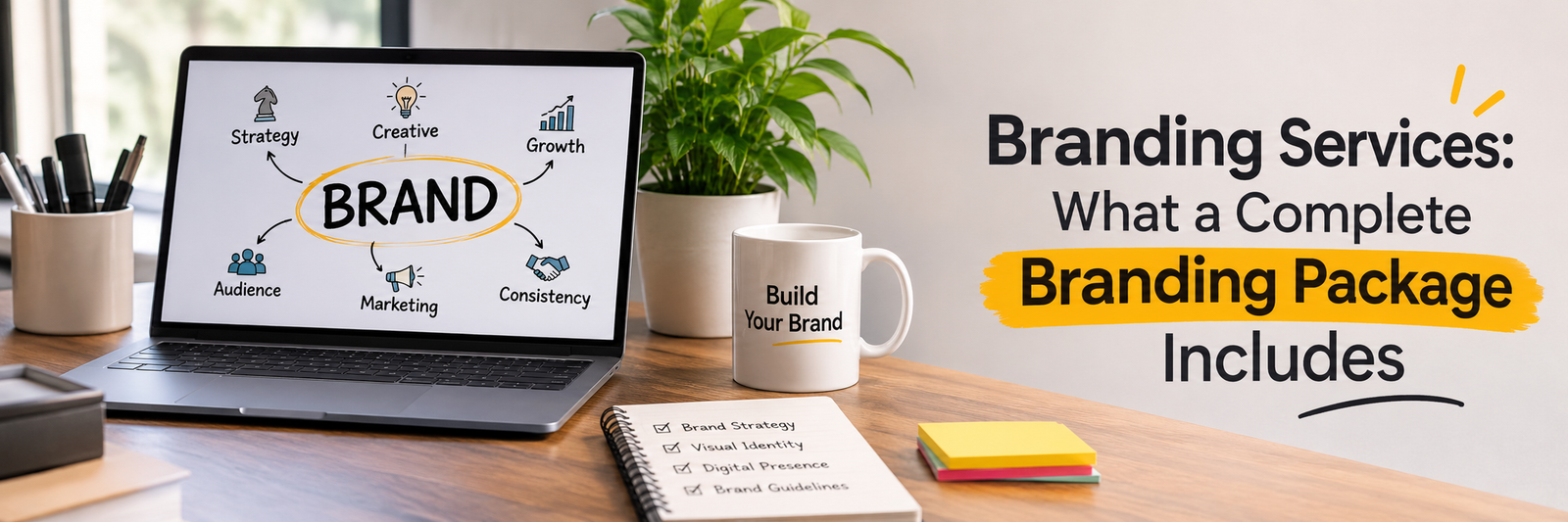
Branding Services: What a Complete Branding Package Includes

Picture two chai stalls on the same Bengaluru street. Same tea, same price, same wobbly plastic stools. Yet one has a queue snaking past the bus stop while the other waits for customers. The difference is rarely the recipe. It is the name on the board, the colour of the cup, the line painted on the wall and the way the owner greets you. That, in a nutshell, is branding.

After 18 years and more than 50 brands transformed at Honeycomb, we have learnt something most businesses discover too late: they do not lack a logo, they lack a system. So before you sign up for branding services that promise “a fresh new look in a week”, stay with us. We are unpacking exactly what a complete branding package includes, which pieces you cannot afford to skip, and how to spot a branding agency that builds brands instead of just drawing them.


Why Do Branding Services Matter More Than Ever?

Indian buyers now meet your business in a dozen places before they ever speak to you. A LinkedIn post, a Google result, a WhatsApp forward, a trade show booth, a product unboxing. If each of those touchpoints looks and sounds different, trust leaks out quietly.

Professional branding services plug that leak. They give your business a consistent visual identity, sharp brand positioning and a recognisable personality, so every interaction adds to the same memory. Think of it as compound interest for your reputation. That consistency is what drives brand recall and, eventually, brand loyalty.

We see this most clearly with B2B companies in IT, manufacturing, pharma and healthcare, where most of our branding work happens. Long sales cycles and committee-style buying decisions punish brands that look different on every slide. When Aques Technology Solutions came to us, they had no cohesive brand identity or clear visual direction. Once we built one, their COO told us it gave their marketing a far stronger foundation. That is the real return on branding: every rupee you spend on marketing after it works harder.


What Does a Complete Branding Package Include?

A complete branding package is not a logo with a few colour swatches attached. At Honeycomb, we treat it as a working toolkit that should serve your sales team in Pune as well as your packaging vendor in Gujarat. Here is what a genuine package should contain.

1. Brand Discovery and Research

Every project we take on starts with diagnosis, not design. We study your business goals, customers, competitors and category conventions. This phase often surfaces uncomfortable truths, like a product range that has outgrown its name, and those truths shape everything that follows.

2. Brand Strategy and Positioning

This is the blueprint: brand purpose, value proposition, audience personas, brand personality and competitive positioning. Skip it and your designers are simply decorating guesswork. We insist on locking the brand strategy before a single sketch is made.

3. Logo Design and Visual Identity

The face of your brand. Good brand identity services deliver a primary logo, secondary versions, an icon or monogram, and clear usage rules for light and dark backgrounds. A strong logo design stays legible on a tiny browser favicon and on a highway hoarding alike.

4. Colour Palette and Typography

A defined colour system with primary, secondary and accent colours, complete with HEX, RGB, CMYK and Pantone codes. Add a typography hierarchy for headlines, body copy and digital screens. These two elements quietly do more for recognition than most founders realise.

5. Brand Voice and Messaging

How your brand sounds matters as much as how it looks. This covers your tagline, elevator pitch, key messages and tone of voice. Our copywriters work alongside our designers, so words and visuals are built together rather than stitched together later.

6. Brand Guidelines

Your brand book, or brand style guide, is the rulebook that keeps everyone consistent long after the agency steps away. We keep ours practical, with real dos and don’ts your team will actually use, not a 90 page PDF nobody opens.

7. Brand Collateral and Stationery

Business cards, letterheads, email signatures, presentation templates, brochures and company profiles. For Sacumen, our team translated their positioning into a polished brochure that matched their brand and their industry perfectly.

8. Digital Brand Assets

Social media templates, website style elements, ad layouts and icon sets. Your brand lives on screens first, so these assets must be platform ready from day one.

9. Brand Rollout and Implementation Support

This is the step most agencies quietly leave out. A new identity has to be applied to your website, signage, packaging, presentations and sales decks, and your internal team needs to understand why the brand looks and sounds the way it does. We stay involved through implementation, applying the brand across digital and physical touchpoints and handing over organised master files, so the launch feels confident rather than chaotic.


How Do You Choose the Right Branding Agency?

Not every branding agency offers the same depth, and a beautiful portfolio is only half the story. Before you sign, ask these five questions:

  • Do they start with strategy, or jump straight to logo options?
  • Have they built brands in industries similar to yours?
  • Do strategy, design, copywriting and production sit under one roof?
  • Will they help roll the brand out, or simply hand over files?
  • How many of their clients stay with them long term?


That last question tells you a lot. Around 60 percent of Honeycomb’s clients stay with us for the long haul, and teams at Titan, Infosys, Carl Zeiss and Honda trust us with their creative work. Here is our honest opinion after nearly two decades in this business: the cheapest logo is often the most expensive one. A rebranding exercise two years later costs far more than doing it right the first time. Watch out for red flags too: fixed price packages that never ask about your customers, three logo options delivered in 48 hours, or a proposal that ends at file handover. Branding is a business decision, so treat your agency like a strategic partner, not a vendor.


Is Your Brand Ready to Be Remembered, Not Just Recognised?

A logo gets you noticed. A complete branding package gets you remembered, trusted and chosen. Strategy, identity, voice, guidelines and assets are not optional extras. Together, they form the system that makes every future campaign easier and more effective.

At Honeycomb, we have spent 18 years helping startups, growing businesses and established enterprises across Bengaluru, Mumbai and beyond build identities that work as hard as they do. Our brand identity services bring discovery, strategy, design, implementation and rollout together under one roof, so nothing gets lost in translation. Whether you are launching a startup, repositioning after a merger or simply tired of explaining what your company does, the right branding services turn that challenge into a clear, confident story.

Ready to stop blending in? Talk to Honeycomb’s branding team today or explore our branding services and let’s build a brand your customers simply cannot ignore.


Frequently Asked Questions

What are branding services?

Branding services help a business define and express who it is. They typically include research, brand strategy, logo and visual identity design, messaging, brand guidelines and the rollout of the brand across every touchpoint.

What does a complete branding package include?

A complete branding package usually covers brand discovery, positioning, logo design, colour palette, typography, brand voice, brand guidelines, stationery, marketing collateral and digital brand assets for web and social media.

How much do branding services cost in India?

Costs depend on scope and company size. At Honeycomb, a foundational brand identity project for a mid-size company typically starts at 3 to 5 lakh rupees, while comprehensive corporate rebranding can range from 10 to 30 lakh rupees or more.

How long does a branding project take?

It depends on the scope. A focused identity project takes a few weeks, while a full rebrand with strategy, guidelines and rollout can run for a few months. A good branding agency shares a clear timeline in its proposal.

What is the difference between branding and brand identity?

Branding is the overall process of shaping how people perceive your business. Brand identity is the visible and tangible part of it: your logo, colours, typography, imagery and voice.

Do I need a branding agency if I already have a logo?

Often, yes. A logo is only one piece. Without strategy, guidelines and consistent assets, a logo alone cannot build recognition or trust across channels.

Does Honeycomb offer rebranding services?

Yes. Honeycomb helps companies across IT, manufacturing, pharma, healthcare and more with identity overhauls, brand architecture changes and communication updates, managing both the creative work and the rollout.

Branding and Packaging Design for D2C Brands in India (2026 Guide)

Your customer decides whether to trust your D2C brand in the ten seconds after a delivery partner hands over the parcel. No ad, influencer reel or discount code gets a vote. The box does all the talking.

In 2026, Indian shoppers meet hundreds of brands a day, yet they remember only the few that felt considered when the carton reached their hands. When branding and packaging design work as one system, that moment becomes your cheapest marketing channel. When they do not, it becomes a return request. Here is how to build the first kind.

Why Branding and Packaging Design Are One Job

Most founders brief a logo first and a box later, often with different vendors. The result is a brand that looks confident on Instagram and confused in the hand. At Honeycomb, a branding and creative agency with 18 years of experience, we treat the pack as the brand’s most physical page. Colour, typography, tone of voice and material must all say the same thing.

Your brand identity is the promise. Your packaging is the proof. A premium positioning printed on thin stock with a cluttered label breaks that promise before the product is even opened.


Five Shifts Shaping D2C Packaging in India in 2026

  • Marketplace-first thumbnails. Your pack must read at thumbnail size on Amazon and quick-commerce apps, not just on a shelf. Bold hierarchy beats fine detail.
  • Regional confidence. Bilingual labels and local cultural cues are now a strength, not an afterthought.
  • Sustainable packaging with proof. Buyers distrust vague green claims. State the material and how to dispose of it.
  • Unboxing as content. A thoughtful unboxing experience gets filmed, shared and remembered. That is free reach.
  • Scalable systems. Variants, sizes and festive editions need one flexible design system, not twelve separate designs.

How a Branding Agency in India Should Work

A good branding agency in India diagnoses before it decorates. Our process follows five steps:

  1. Product discovery: We study your product, audience, competitors and price point before any creative work begins.
  2. Concept development: We explore structure and visuals together, balancing shelf appeal with function.
  3. Design development: Typography, colour and graphics are refined into one cohesive packaging system.
  4. Artwork and production: Files are prepared for print with technical accuracy. Many beautiful designs die at the printer, so we plan for production from day one.
  5. Final delivery: You receive production-ready assets and guidelines, so every future SKU stays on brand.


The Five-Question Test Before You Print

Before any pack goes to production, run it through these questions. Our opinion is that a design which fails even one of them is not ready.

  • Can a stranger tell what it is in three seconds? Category and benefit should be obvious at a glance.
  • Does it still work at thumbnail size? Shrink the artwork to the size of a phone screenshot and check.
  • Does it feel like your brand voice? A playful brand should not ship a stiff, corporate label.
  • Can it stretch across variants? Add a new flavour, size or shade and see whether the system holds.
  • Can it be made at your target cost? Board, finish and print method must match your margins.

Where to Spend and Where to Save

Founders often overspend on embellishments and underspend on fundamentals. Invest in clear hierarchy, sound structure and one memorable tactile moment, such as a distinctive closure or insert. Save by standardising box formats across variants, limiting special finishes to hero products and designing label systems that share a common template. Smart packaging design is rarely about spending more. It is about spending where the customer actually notices.


Four Mistakes We See Again and Again

  • Designing for the photoshoot, not the shelf. A pack that looks stunning on a white background can disappear in a crowded aisle or a tiny app thumbnail.
  • Cramming every claim onto the front panel. Clarity builds trust. Choose one hero message.
  • Ignoring production realities. Board, finish and cost per unit decide whether a design survives scale.
  • Skipping brand guidelines. Without them, every new SKU drifts a little further from the original idea.

Your Box Is the Only Salesperson Who Never Sleeps

Think about what a D2C brand cannot control: courier delays, rising ad costs, competitor discounts. Now think about what it can. Every parcel is a controlled, repeatable, zero-media-cost meeting with a paying customer. Strong packaging lifts perceived value, supports a higher price, reduces the confusion that leads to returns, and hands your customers something worth sharing. Brands that treat it as an afterthought pay for it in every ad rupee they spend to make up the difference.

That is the case Honeycomb makes to every founder. As a creative agency that brings strategy, design, content and production under one roof, we build identities and packs that work together from the first brief to the final print file.

Ready to turn your next parcel into your best pitch? Explore our packaging design services at stg.honeycombindia.net/, or book a call with the Honeycomb team today.

Frequently Asked Questions

What is branding and packaging design for D2C brands?

It is the combined work of defining your brand’s identity, voice and visual language, then applying it to your box, label and inserts so the product feels consistent from first glance to unboxing.

How much should a D2C brand spend on packaging?

There is no fixed figure. Start with your target margin and cost per unit, then design within that limit. Smart design often adds more perceived value than a costlier material would.

Do I need a brand identity before packaging design?

Yes. Packaging is the most visible application of your identity. Designing it first usually means redoing it later.

How do I choose the right branding agency in India?

Look for strategy before aesthetics, relevant experience, in-house production knowledge and a clear process. Ask how the agency prepares print-ready artwork.

Can sustainable packaging still feel premium?

Absolutely. Thoughtful material choices, clean structure and honest labelling can feel more premium than heavy, over-finished packs.

Can one design system cover multiple product variants?

It should. A scalable system keeps every variant recognisable as part of one brand while making each one easy to tell apart.

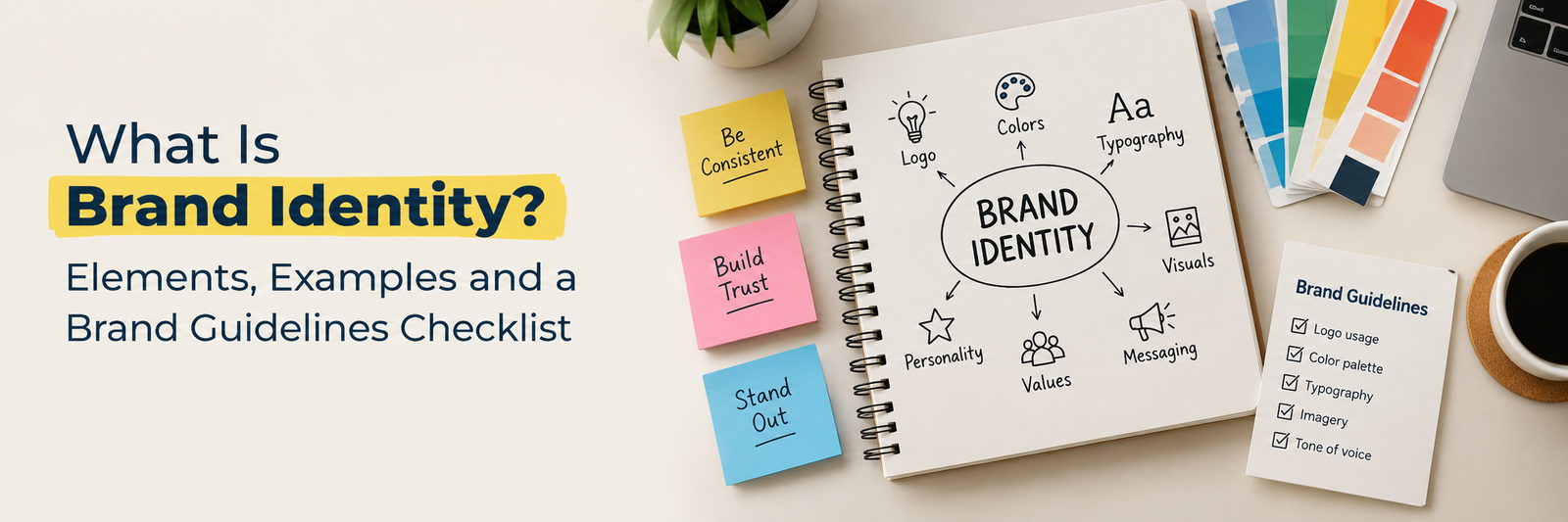
What Is Brand Identity? Elements, Examples and a Brand Guidelines Checklist

Cover your logo with your thumb. Can a stranger still tell it is you? The colour on the shelf, the tone of the caption, the feel of the brochure in their hand: that quiet recognition is brand identity at work. It decides whether customers remember you or scroll past you. At Honeycomb India, we have spent 18+ years and 50+ brand transformations learning one thing: businesses rarely lose because of effort. They lose because of inconsistency. Read on and fix that.

What Is Brand Identity?

Brand identity is the set of visual and verbal signals a business chooses to express who it is. It includes your logo, colours, typography, imagery, voice and the experiences built around them. Brand image is what people think of you. Brand identity is what you deliberately do to shape that thought. Good brand identity design turns a business name into a personality people recognise and trust.

Why Does Brand Identity Matter for Business Results?

Because recognition compounds. Every inconsistent touchpoint forces a buyer to re-evaluate you. Every consistent one adds a small deposit of trust. Over time, that trust shortens sales cycles, improves lead quality and lets you compete on value instead of price. A clear identity also makes every rupee of marketing work harder, since your ads, website and sales decks reinforce one idea instead of five.

What Are the Core Elements of Brand Identity?

Think of these seven elements as a system, not a menu.

  • Brand strategy: Purpose, positioning, audience and values. Everything else stands on this.
  • Logo system: Primary mark, secondary versions, icon and clear space rules.
  • Colour palette: A deliberate set with defined roles, not a pile of favourites.
  • Typography: Typefaces and a hierarchy for headlines, body text and captions.
  • Imagery and iconography: The photography, illustration and icon style that signals your world.
  • Voice and messaging: How you sound, including words you use and words you avoid.
  • Brand applications: Packaging, website, social media, decks and print.

Strong graphic design branding ties these together so they feel like one voice.

Which Brand Identity Examples Show It Working?

Amul has spoken in the same witty, topical voice for decades, and Indians recognise its hoardings in a second. Nike’s swoosh needs no name beside it. Apple’s restraint is itself the message. Different industries, same principle: one idea, repeated with discipline.

Now a story from our own studio. Anamala Homestays in Thiruvilwamala, Kerala, carries a 70-year hospitality legacy, yet its visuals were purely functional. We began with brand strategy and landed on the positioning “Live a little more Kerala.” The logo mark merged a Nalukettu courtyard form, an Athangudi-inspired motif and a circle of harmony. The palette came from the property’s own landscape: brick red, verdant green and sunlit yellow. We paired Playfair Display with the Malayalam typeface Anakha for bilingual consistency, then designed welcome letters, postcards and room cards to carry the idea through.

The result gave the Summer 2026 campaigns a strong creative foundation, which contributed to 2,036 leads and a 32% year-on-year rise in seasonal revenue, from ₹24.1 lakh to ₹31.9 lakh. Identity done properly is not decoration. It is commercial infrastructure.

What Do Most Brands Get Wrong?

They start with the logo. Our opinion, shaped by work with 200+ clients: a logo is a signature, not a strategy. We are an insight-led agency that diagnoses first, uncovering the real business challenge before a single sketch begins. Aques Technology Solutions came to us without a cohesive identity or clear visual direction, and the brand identity we built gave their marketing a much stronger foundation. Because strategy, design, copywriting and video sit under one roof at Honeycomb, the identity never gets diluted between vendors.

What Should a Brand Guidelines Checklist Include?

Brand guidelines are the rulebook that protects your identity as more people start using it. Use this checklist:

  • Brand story, mission, vision and values
  • Positioning statement and target audience
  • Logo versions, clear space, minimum sizes and misuse examples
  • Colour palette with HEX, RGB and CMYK values
  • Typography hierarchy with fallback fonts
  • Imagery, photography and icon style
  • Voice, tone and a words-to-use list
  • Layout grids for print and digital
  • Social media and website usage rules
  • Packaging, stationery and presentation templates
  • An approval process and a named brand owner

How Do You Build a Brand Identity Step by Step?

Follow five moves: diagnose your market and audience, define your positioning, design the visual and verbal system, document it in guidelines, then deploy it across every touchpoint. Skip a step and the identity wobbles.

Conclusion: Your Brand Is Already Talking. Is It Saying the Same Thing Everywhere?

Every business has an identity, whether designed or accidental. The accidental kind sends mixed signals: one colour on the website, another on the brochure, a different tone on LinkedIn. The designed kind compounds trust, sharpens positioning and makes marketing spend go further. The case is simple. Customers buy what they recognise and trust, and recognition is built by consistency.

At Honeycomb India, we combine brand strategy, brand identity design and brand guidelines with web, digital and print, so your brand speaks with one confident voice everywhere. Ready to be unmistakable? Visit Honeycomb India to explore our branding services and case studies, or call +91 90352 90915 to start your brand transformation today.

Frequently Asked Questions

What is the difference between brand identity and branding?

Brand identity is the tangible set of assets and rules, such as logo, colours and voice. Branding is the ongoing process of building perception using those assets.

How long does brand identity design take?

It usually takes several weeks, depending on research depth, the number of applications and how quickly approvals come in.

What is the difference between brand guidelines and a brand strategy?

Brand strategy defines who you are and why you matter. Brand guidelines document how that strategy looks and sounds in practice.

When should a business update its brand guidelines?

Update them when you rebrand, enter new markets, launch new channels or notice inconsistent output across teams and vendors.

Can a small business invest in brand identity design?

Yes. Start with strategy, a logo system, palette, typography and lean guidelines, then expand as the business grows.

Does brand identity affect SEO and website performance?

Indirectly, yes. A consistent identity builds trust and recall, which supports branded searches, click-through rates and conversions.

10 Creative Branding Ideas for Businesses in 2026

Walk into any co-working space in Koramangala or Indiranagar today, and you will notice something. Every second laptop sticker, every third pitch deck, every founder’s LinkedIn banner is screaming for attention in almost the same visual language. Bangalore in 2026 is not short on ambition. It is short on brands that actually stand out once the funding slide is over and the real work of building trust begins. If you are a business owner in this city wondering why your product is good but your brand feels invisible, this is the article for you. We’ll walk through ten creative branding ideas that genuinely move the needle, drawn from what works when a skilled Branding Service builds a brand from the ground up. Stay with us till the end, because the last idea is the one most businesses skip, and it is usually the one that makes the biggest difference.

Top 10 Creative Branding Ideas for Businesses

1. Build a Brand Story Rooted in Bangalore’s Own Energy

Bangalore is a city of contrasts: heritage lanes next to glass towers, filter coffee next to third wave cafes. Smart brands borrow this energy instead of ignoring it. A strong Branding Agency will dig into your founder’s journey, your city’s culture, and your customer’s daily life to craft a story that feels local and aspirational at once. Generic taglines fade. Rooted stories stick.


2. Design a Visual Identity System, Not Just a Logo

A logo alone cannot carry a brand anymore. Businesses need a full identity system covering typography, colour palette, iconography, and layout rules that hold up across web, print, and social media. This is where professional Branding Services earn their fee. Consistency across every touchpoint builds the kind of recognition that a single pretty logo never will.


3. Use Sustainable and Local Materials in Print Branding

Bangalore’s customers, especially the younger demographic, respond strongly to sustainability. Businesses using recycled paper, soy-based inks, or locally sourced packaging materials for their print collateral send a quiet but powerful message about their values. Print is far from dead here. It is simply being reimagined with a conscience.


4. Create a Distinct Brand Voice for Digital Platforms

Visual identity gets a business noticed. Voice is what makes people stay. Whether it is witty, warm, or authoritative, your brand voice should be documented and applied consistently across your website copy, social captions, and email campaigns. Honeycomb often builds tone of voice guidelines alongside visual guidelines, because a brand that looks sharp but sounds inconsistent confuses customers.


5. Invest in Custom Illustration and Iconography

Stock imagery is easy to spot and even easier to forget. Custom illustration and bespoke iconography give a brand a signature look that competitors simply cannot copy overnight. For SaaS companies, D2C brands, and service businesses alike, original visuals are becoming one of the strongest differentiators in a crowded Bangalore market.


6. Leverage Motion and Video for Brand Storytelling

Short form video is not a trend anymore, it is the default way audiences consume information. Businesses that invest in brand films, product explainers, and social reels with consistent visual branding see far stronger recall. Video production paired with strategic branding turns a scroll-stopping moment into a memorable brand impression.


7. Build a Cohesive Packaging Experience

For product and D2C businesses, packaging is often the first physical touchpoint a customer has with your brand. Thoughtful unboxing experiences, on-brand packaging design, and small personal touches like handwritten notes or QR codes leading to a welcome video can turn a simple delivery into a shareable moment.


8. Align Your Website Design with Your Brand Personality

A beautiful brand identity loses its power if the website feels like an afterthought. Bangalore businesses need websites that are fast, mobile-friendly, and visually aligned with their brand guidelines down to the last pixel. Web design and branding should never be handled in silos. When they are built together, conversions follow naturally.


9. Develop Signature Brand Assets for Social Recognition

Think of the Cadbury purple or the Zomato red. Bangalore brands can build their own version of this through a signature colour, pattern, sound, or even a mascot that customers instantly associate with them. This kind of visual shorthand is one of the most underrated branding tools available to growing businesses.


10. Run Regular Brand Audits as You Scale

The branding idea most businesses skip is the simplest one: revisiting your brand identity as your company grows. What worked when you had ten customers may not work when you have ten thousand. A periodic brand audit, checking your visual identity, messaging, and customer perception, keeps your brand relevant instead of letting it quietly go stale.

Related Read: Why Professional Corporate Branding Services Are Worth the Investment


Why Honeycomb Is the Branding Agency Bangalore Businesses Trust

So here is the real question every founder should be asking. Is your brand actually working for you, or is it just sitting there looking presentable while your competitors pull ahead? At Honeycomb Creative Support, we have spent years helping Bangalore businesses move from forgettable to unforgettable. Our strength lies in offering complete Branding Services under one roof: strategy, design, web development, digital marketing, video production, and premium printing, all working in sync instead of scattered across five different vendors. That integration is exactly why our clients see consistent, compounding brand recognition instead of one-off design wins. A great brand is not built in a single project. It is built through a strategic partner who understands your story, your customers, and your city. If you are ready to build a brand that people remember, trust, and choose again and again, it is time to talk to Honeycomb. Visit the Honeycomb Creative Support website today and let us turn your business into a brand Bangalore cannot ignore.


Frequently Asked Questions

Q1. What does a Branding Agency in Bangalore actually do?
A Branding Agency helps define your brand strategy, visual identity, tone of voice, and customer experience, then applies it consistently across every platform your business uses, from your website to your packaging.

Q2. How much do professional Branding Services cost in Bangalore?
Costs vary widely depending on scope, ranging from focused logo and identity projects to full brand strategy engagements. Most agencies, including Honeycomb, scope pricing based on your business size and the channels you need covered.

Q3. How long does a full branding project usually take?
A comprehensive branding project, covering strategy, identity design, and collateral, typically takes four to eight weeks, depending on how many touchpoints are involved and how quickly feedback rounds move.

Q4. Can small businesses in Bangalore benefit from professional branding?
Absolutely. Small and mid-sized businesses often see the fastest impact from professional branding, since a strong, consistent identity helps them compete credibly against larger, better-funded competitors.

Q5. Is rebranding necessary if my business is already established?
Not always, but a brand audit is worth doing every few years. If your visual identity or messaging no longer matches your growth stage or customer base, a refresh can significantly boost recognition and trust.

Q6. Does branding really affect sales and customer loyalty?
Yes, consistently. Customers are more likely to trust, remember, and recommend businesses with a clear, professional brand identity, which directly influences repeat purchases and referrals.

Q7. What makes Honeycomb different from other branding agencies in Bangalore?
Honeycomb combines branding, web design, digital marketing, video, and print under one integrated team, ensuring your brand identity stays consistent across every channel instead of being diluted across multiple vendors.

Why Professional Corporate Branding Services Are Worth the Investment

Picture two companies selling the exact same product at the exact same price. One looks like it was put together in an afternoon: a mismatched logo, a design that feels stuck in 2015, and marketing materials that seem to disagree with each other. The other feels intentional. Every touchpoint, from the business card to the app icon, tells the same story. Which one would you trust with your money?

Most buyers answer that question in seconds, often without realising it. Branding isn’t decoration. It’s the fastest signal a company sends about whether it can be trusted, and it’s usually judged before a single word of copy is read. That’s the quiet power a Corporate Branding Agency brings to the table, and it’s why the investment pays for itself far beyond the initial project fee.

The Real Cost of Inconsistent Branding

Founders often treat branding as a line item to trim when budgets tighten. It’s an understandable instinct. Unlike a new hire or a software subscription, branding doesn’t show up as a visible cost centre on a spreadsheet. But inconsistency has a price too, it’s just harder to see.

Think about a prospect who visits your website, then finds your LinkedIn page, then walks into your office or scans your product packaging. If those three experiences feel like three different companies, trust erodes with every step. Confusion is expensive. It slows down sales cycles, weakens customer loyalty, and forces marketing teams to work twice as hard just to explain who you are. Professional corporate branding services exist precisely to close that gap, aligning every visual and verbal element so the brand feels like one coherent voice, everywhere it shows up.

What a Corporate Branding Agency Actually Does

There’s a common misconception that a branding agency just designs a nicer logo. In reality, a capable Corporate Branding Agency operates closer to a business strategist than a design shop. The work usually starts with research: understanding your industry, your competitors, and the emotional territory your audience already associates with brands like yours.

From there, the agency builds a visual identity system, covering everything from typography and colour palettes to iconography and photography style, alongside a verbal identity that defines tone of voice, messaging pillars, and brand story. The output isn’t just a pretty deck. It’s a usable brand guideline that internal teams, external vendors, and future hires can reference for years, keeping the brand consistent long after the agency’s project has wrapped.

This is where corporate identity design earns its value. It isn’t about chasing trends. It’s about building a visual and verbal system flexible enough to grow with the company while staying recognisable at every stage.

Why Corporate Branding Services Deliver Real ROI

Business owners reasonably ask whether design spend actually moves the needle on revenue. The evidence, both anecdotal and measurable, tends to say yes.

Strong branding shortens the distance between discovery and decision. When a prospect immediately understands who you are and what you stand for, sales teams spend less time on basic education and more time on genuine conversation. Consistent corporate branding services also strengthen brand recognition, which compounds over time. Every touchpoint that reinforces the same identity makes the next impression land faster and stick longer.

There’s also a talent dimension that gets overlooked. A polished, confident brand doesn’t just attract customers, it attracts better candidates too. People want to work somewhere that looks like it knows where it’s going. And when a company eventually raises funding, seeks partnerships, or enters new markets, a credible brand identity acts as a silent reference check, signaling maturity before a single conversation happens.

Related Read: Corporate Branding for Startups in India (2026)

Signs Your Business Needs Corporate Branding Services

A few patterns tend to show up right before a company realises it’s time to invest:

  • Your visual identity hasn’t been touched since the company was founded, and the business has changed dramatically since then.
  • Different departments are using different logo versions, colours, or messaging without anyone noticing.
  • Customers frequently ask what your company actually does, even after visiting your website.
  • You’re entering a new market or launching a new product line and the existing brand doesn’t stretch to cover it.
  • Competitors with weaker products are winning deals simply because they present better.


Any one of these is a reasonable trigger. Two or three together usually mean the brand is actively costing the business opportunities.

Choosing the Right Corporate Branding Agency

Not every agency approaches branding the same way, and the difference shows up in the results. Look for a partner who asks hard questions before opening a design tool, one who wants to understand your customers and competitive landscape before proposing a single colour. Ask to see how their past work performed, not just how it looked. Strong branding is judged by whether it changed how people perceived and engaged with the business, not by how many design awards it collected.

It also helps to choose a partner who can carry the brand across mediums, from digital platforms to print, packaging, and video, so the identity feels unified rather than fragmented across different vendors handling different pieces.

Honeycomb Creative Support works from exactly that philosophy. As a full service creative agency, Honeycomb pairs strategic brand thinking with hands-on execution across design, web, digital marketing, and print, helping businesses build identities that stay consistent and credible across every channel they touch.

Build a Brand That Earns Trust Before You Say a Word

A logo can be copied. A colour palette can be imitated. What can’t be replicated is a brand built on genuine strategy, consistency, and craft, the kind that makes people feel something before they’ve even read your pitch. That’s the real return on investing in professional branding: not just a better-looking company, but one that’s easier to trust, easier to remember, and easier to choose.

If your business is ready for an identity that matches the quality of what you actually do, Honeycomb Creative Support’s Graphic Design team is ready to help you build it. Visit Honeycomb Creative Support to start the conversation.

Frequently Asked Questions

How long does a typical corporate branding project take?
Most engagements run between six and twelve weeks, depending on the depth of research, the number of stakeholders involved, and how many touchpoints need to be redesigned.

Is corporate branding only necessary for large companies?
No. Small and mid-sized businesses often benefit even more, since a clear brand identity helps them compete against larger, better-funded competitors without matching their marketing budgets.

What’s the difference between branding and marketing?
Branding defines who you are and how you’re perceived. Marketing is how you communicate that identity to drive action. Marketing built on weak branding tends to underperform, no matter how clever the campaign.

How often should a brand identity be refreshed?
There’s no fixed timeline, but most businesses revisit their identity every three to five years, or sooner if the business model, audience, or market position shifts significantly.

Can branding really be measured in terms of ROI?
Yes, through indicators like improved conversion rates, shorter sales cycles, higher customer retention, and stronger brand recall in surveys or market research.

Corporate Branding Agency for B2B Companies in India

B2B companies have a strange relationship with branding. Ask a manufacturing firm or an industrial services company about their brand, and many will point to their product specifications, their client list, or their years in business. Branding, if it comes up at all, gets treated as something consumer companies worry about, not something that applies to a business selling to other businesses.

That assumption costs B2B companies more than they realise. A distributor evaluating three potential suppliers, a procurement head shortlisting vendors, or an enterprise buyer researching a new partner all form an opinion about credibility long before a sales call happens, based almost entirely on how professional and consistent a company presents itself. This is exactly where a corporate branding agency becomes relevant, not as a nice-to-have for companies with consumer-facing products, but as groundwork for any business trying to win trust before a relationship even begins.


Why B2B Branding Gets Overlooked

Part of the reason is structural. B2B sales cycles are longer and more relationship-driven than B2C, so companies assume the relationship itself does the persuading, and branding is just decoration around it. But relationships have to start somewhere, and increasingly, they start with research done entirely online, before a prospect ever picks up the phone.

A procurement manager comparing vendors will look at your website, your case studies, and your overall presentation before reaching out. If that first impression feels inconsistent or dated, you may never get the chance to have the relationship-building conversation that B2B companies rely on so heavily.


What Corporate Branding Actually Means for a B2B Company

This is where clarity matters. Corporate branding services are not about making an industrial company look flashy or consumer-friendly. They are about building a coherent identity, positioning, messaging, and visual system that communicates competence, reliability, and expertise clearly and consistently across every touchpoint a buyer might encounter.

For a B2B company, that often includes things a consumer brand rarely worries about: technical documentation that still reflects brand consistency, a corporate presentation that holds up in a boardroom, an annual report that reinforces credibility with investors, and a website that speaks to procurement teams and technical evaluators, not just casual browsers.

Related Read: Best Branding Services in India


The Trust Gap B2B Buyers Actually Feel

Here is a belief worth sitting with: B2B buyers do not choose vendors purely on capability. They choose based on perceived reliability, and perception is shaped heavily by presentation. Two companies with comparable technical capability will not get equal consideration if one looks significantly more professional, current, and consistent than the other. Buyers rarely say this out loud, since nobody wants to admit a decision was influenced by a website, but it happens constantly, especially in the early shortlisting stages before technical evaluation even begins.


Where Branding Fits Into a Long B2B Sales Cycle

Unlike a consumer purchase, B2B decisions often involve multiple stakeholders, a technical evaluator, a procurement lead, a finance approver, sometimes a CEO signing off at the end. Each of these people forms an impression at a different touchpoint. A technical evaluator might review a product spec sheet. A finance approver might glance at your company profile. A CEO might only see your homepage for thirty seconds before a final decision.

Strong corporate branding does not try to persuade any single stakeholder with one clever message. It builds enough consistency across every touchpoint that no matter which document or page a stakeholder happens to see, the impression reinforces the same story instead of contradicting it.

Related Read: Top 10 Corporate Branding Agencies in India to Build a Strong Business Identity


Common Branding Mistakes B2B Companies Make

A few patterns show up repeatedly. Companies rely on outdated corporate presentations that have not been touched in years, even as the business itself has evolved considerably. Websites get built once and never revisited, despite the company’s positioning shifting entirely since launch. And perhaps most common, different departments produce materials independently, a sales deck here, a trade show banner there, with no shared visual or messaging system tying them together. The result is a company that looks like three different businesses depending on which document a prospect happens to see first.


What Strong B2B Branding Actually Delivers

Beyond looking more polished, effective corporate branding shortens the trust-building phase of a long sales cycle. When a prospect already senses competence and consistency from your website and materials, the sales conversation starts further along than it would with a company still working to establish basic credibility. It also supports easier fundraising conversations, stronger dealer and distributor relationships, and better recruitment, since technical talent increasingly evaluates a company’s brand presence the same way customers do.


Industries Where This Matters Most

Manufacturing, industrial services, healthcare technology, and enterprise SaaS companies tend to feel this gap most acutely, largely because their sales cycles are long, their stakeholders are numerous, and their competitors are often technically similar enough that presentation becomes a genuine differentiator. In categories where products look interchangeable on paper, brand clarity is frequently the deciding factor in who gets shortlisted at all.


What to Expect From a Corporate Branding Engagement

A properly run engagement typically starts with a brand audit and positioning work, understanding how the company is currently perceived versus how it wants to be perceived. From there, messaging gets refined for the specific stakeholders in a typical buying committee, followed by visual identity work, and finally rollout across the materials that matter most: website, corporate presentation, case studies, and sales collateral. Skipping straight to visual design without this groundwork tends to produce a company that looks better without actually building more trust.


A Word on Honeycomb

Honeycomb Creative Support works with B2B companies across brand strategy, identity design, website development, corporate presentations, and content, building a consistent system rather than a collection of disconnected assets. For a B2B business managing multiple stakeholders across a long sales cycle, that consistency is often what quietly closes the trust gap competitors leave open.


The Real Advantage Nobody Talks About

Most B2B companies compete on capability, assuming a strong product speaks for itself. But capability is table stakes in most industries by now. What actually differentiates one credible vendor from another, in the eyes of a buyer comparing several similar options, is how clearly and consistently that credibility gets communicated. That is not a marketing nicety. It is often the actual deciding factor in who gets the meeting at all.

If your business has strong capability but a brand presence that has not kept pace, it is worth finding out where that gap is costing you opportunities. Reach out to Honeycomb for a free corporate branding audit and see how your current presentation compares to what your buyers are actually evaluating.


Frequently Asked Questions

1. Do B2B companies really need corporate branding?
Yes. B2B buyers form impressions about reliability and competence long before direct contact, often based on a website or corporate presentation. Strong branding shortens the trust-building phase of a typically long sales cycle.

2. What is the difference between corporate branding and marketing for a B2B company?
Corporate branding builds the underlying identity, positioning, and messaging a company communicates consistently. Marketing uses that identity to generate demand. Branding should come first, since marketing without clear positioning tends to underperform.

3. What do corporate branding services typically include?
Brand strategy and positioning, visual identity design, messaging development, and rollout across key materials like websites, corporate presentations, case studies, and sales collateral.

4. How does branding help with B2B sales cycles?
By building consistent credibility across every stakeholder touchpoint, from a technical evaluator’s spec review to a CEO’s brief glance at the homepage, the impression stays coherent no matter who sees what first.

5. Which industries benefit most from strong B2B branding?
Manufacturing, industrial services, healthcare technology, and enterprise SaaS tend to benefit most, particularly where products are technically similar and presentation becomes a genuine differentiator.

6. How long does a corporate branding engagement usually take?
It varies by scope, but a typical engagement covering brand audit, positioning, identity, and rollout across core materials generally takes six to ten weeks.

Best Branding Services in India for Startups and Growing Businesses

Startups rarely fail because the product was bad. They fail because nobody trusted the product enough to try it in the first place. And trust, more often than not, starts with how a brand looks, sounds, and feels before a customer even reads what you actually do.

This is exactly why more founders across India are searching for the Best Branding Services, not after they have raised a big round or hit a revenue milestone, but right at the point where they are trying to be taken seriously for the first time. Let’s talk about what actually matters when you are building a brand from the ground up, or reshaping one that has outgrown its early identity.


Why Do Startups Need Branding Earlier Than They Think?

Most founders assume branding is a later-stage problem, something to worry about once the product is stable and revenue is coming in. In reality, the opposite is true. Early impressions are incredibly hard to undo. If your first pitch deck, website, and social presence look inconsistent or amateur, that perception sticks in the minds of investors, early customers, and potential hires long after you fix it.

A professional Branding Agency helps you get this right from day one, so you are not spending your growth phase trying to convince people you are more credible than your current visual identity suggests.


What Is the Real Difference Between a Logo and a Brand?

This confusion trips up so many early-stage businesses. A logo is one asset. A brand is the entire experience someone has with your business, how your website feels, how your team communicates, what your packaging says about your values, and the emotional response people have when they think of you.

Founders who invest only in a logo and skip the deeper strategy usually end up rebuilding everything within a year or two, because a logo without a clear brand foundation behind it simply cannot carry the weight of a growing business.

Related Read: Top Reasons to Hire a Professional Branding Agency in India


How Should a Startup Think About Branding on a Limited Budget?

This is a fair and common concern, and the honest answer is that branding does not have to mean an expensive, months-long overhaul. What it does need is intentionality. A startup does not need fifteen brand assets on day one. It needs a clear, well-thought-out identity covering the essentials, logo, colour palette, typography, tone of voice, and a simple set of guidelines, built with enough strategic thinking that it can scale as the business grows.

Working with the right partner for Corporate Branding Services early on actually saves money long term, since you avoid the far more expensive cost of a full rebrand later.


Why Does Brand Consistency Matter So Much for Growing Businesses?

As a business grows, more people start creating content on its behalf, marketing teams, freelancers, sales decks, social media managers, sometimes all at once. Without clear guidelines, this is exactly when brands start to look fragmented. One post looks polished, another looks completely different, and customers quietly start to notice.

A Corporate Branding Agency solves this by creating a documented system, not just a set of pretty assets, so that everyone creating content for your business, internal or external, stays aligned without needing to ask for approval on every small decision.


What Should Founders Actually Look for in a Branding Partner?

Not every agency is the right fit for every stage of business. Here is what genuinely matters when evaluating options.

Look for a partner who asks about your business model and audience before showing you mood boards. Strategy should always come before visuals. Look for evidence of research based thinking, not just an impressive portfolio of pretty logos. Ask how they think about scalability, since your five person startup today might be a fifty person company in two years, and your brand identity needs room to grow with you, not constrain you.

Finally, look for a partner who understands the Indian market specifically. A Branding Agency that understands local consumer behaviour, cultural context, and regional nuance will build something that resonates here, while still being credible if you expand internationally later.


How Does Branding Actually Help Startups Raise Funding and Win Customers?

Investors evaluate hundreds of pitch decks, and founders who present a coherent, professional brand identity signal something important without saying a word, that they understand how to build something people will trust. The same logic applies to your first customers. In a market where trust is earned quickly or lost instantly, a confident, consistent brand does real work in shortening that trust-building process.

This is not a soft, immeasurable benefit either. Businesses with strong, consistent branding often see better conversion rates on their websites, more referral traffic, and stronger retention, simply because people remember and recommend brands that feel put together and dependable.


How Does Honeycomb Support Startups and Growing Businesses Differently?

At Honeycomb Creative Support, we understand that startups and growing businesses do not need the same approach as a large enterprise rebranding after twenty years. Our process is built to move at the pace founders actually need, without skipping the strategic groundwork that makes a brand last.

We start by understanding the business itself, its goals, its audience, and where it is headed over the next few years, not just where it stands today. From there, our team builds an identity that is genuinely distinctive rather than templated, then documents it clearly so it stays consistent as the business scales.

Because branding, web design, and digital marketing sit under one roof at Honeycomb, the identity we create does not stay locked in a static guideline document. It gets carried across your website, campaigns, and every customer touchpoint, so growth never comes at the cost of consistency. This integrated approach is central to how our Corporate Branding Agency work supports founders who are serious about building something that lasts.


When Should a Growing Business Consider Rebranding Instead of Refreshing?

Not every business needs to start from scratch. Sometimes a brand refresh, sharpening colours, modernising typography, tightening messaging, is enough to signal growth without confusing existing customers. A full rebrand becomes necessary when the business model has fundamentally changed, when you are entering a completely new market, or when your current identity actively works against how you want to be perceived. A good branding partner will tell you honestly which one you actually need, rather than pushing for the bigger, more expensive option by default.


Conclusion

For startups and growing businesses in India, branding is not a finishing touch, it is one of the earliest and most important investments you can make in how the world perceives your business. Getting it right early saves money, builds trust faster, and gives your team a consistent foundation to grow from. Honeycomb Creative Support works closely with founders and growing teams to build brand identities that are strategic, distinctive, and built to scale, so your business looks exactly as credible as the work you are putting into it.


Frequently Asked Questions

1. At what stage should a startup invest in professional branding?

Ideally, before or right around launch. Early impressions with investors, customers, and hires are hard to reverse, so having a clear, professional identity from the start saves both money and credibility later.

2. How much do branding services typically cost for a startup in India?

Costs vary based on scope, but many agencies offer scalable packages suited to early stage budgets, covering the essentials first with room to expand the identity system as the business grows.

3. What is included in a typical startup branding package?

This usually includes brand strategy, logo design, colour palette and typography, tone of voice guidelines, and a basic brand guide, sometimes extending to business collateral and social media templates.

4. How is corporate branding different from startup branding?

Corporate branding for established businesses often involves repositioning, multi-stakeholder alignment, and larger-scale rollout across departments, while startup branding focuses on building a strong, scalable foundation from scratch.

5. Can a growing business rebrand without losing existing customers?

Yes, when done thoughtfully. A phased rollout, clear communication about the change, and retaining core brand elements customers already recognise can make a rebrand feel like evolution rather than disruption.

6. How long does it take to build a brand identity for a startup?

Most startup branding projects take around four to six weeks, depending on how much strategic research and stakeholder input is involved.

7. Does branding really impact fundraising for startups?

Yes, indirectly but meaningfully. A polished, professional brand signals credibility and attention to detail, which can influence how investors perceive a founder’s ability to execute.

8. Why should startups choose an Indian branding agency over an international one?

A local agency understands Indian consumer behaviour, market context, and cultural nuance more intimately, while still being fully capable of building an identity that holds up internationally as the business scales.

Top Reasons to Hire a Professional Branding Agency in India

Every business owner reaches a point where the logo made by a cousin’s friend, or the brand colours picked in a hurry three years ago, just stop working. Your business has grown, your audience has changed, and your brand still looks like it belongs to a different, smaller company. That gap is usually the first sign that it is time to bring in a professional Branding Agency.

This is not about vanity. A strong brand identity directly affects how much people trust you, how much they are willing to pay you, and whether they choose you over a competitor who looks more polished and put together. Let’s look at why hiring the right partner for Branding Services makes such a measurable difference.


Why Does Brand Perception Matter More Than You Think?

People judge businesses the same way they judge people, quickly and mostly on appearance. Within seconds of seeing your website, packaging, or social media page, a potential customer forms an opinion about whether you are credible, professional, and worth their time.

A Corporate Branding Agency understands this psychology deeply. They know how colour, typography, spacing, and tone of voice combine to build trust before a single word of your pitch is spoken. DIY branding or a rushed freelance job often misses these subtleties, leaving your business looking inconsistent or, worse, forgettable.


What Can a Professional Agency Do That You Cannot Do Alone?

Founders and marketing teams are experts in their own business, not necessarily in visual identity, market positioning, or design psychology. That is a different skill set entirely, built through years of studying what actually makes brands stick in people’s minds.

A professional agency brings structured thinking to the table. They start with research, not guesswork, studying your industry, your competitors, and your audience before a single design element is created. This is the real value behind Corporate Branding Services, a process built on strategy first, aesthetics second.


How Does Strong Branding Actually Impact Revenue?

Branding impacts revenue by shortening sales cycles and supporting premium pricing. It is not a cost centre, it is a growth lever.

  • Consistent, professional branding builds recognition, and recognition builds trust.
  • Trust shortens sales cycles because customers spend less time wondering if you are legitimate.
  • A polished brand signals quality even before your product or service proves it, which allows you to charge a premium.
  • Businesses that invest in proper branding consistently report better customer retention and stronger word of mouth, because people remember and recommend brands that feel coherent and confident.


Why Does Consistency Across Platforms Matter So Much?

Consistency matters because your brand shows up everywhere and any mismatch quietly undermines the trust you’re trying to build. Your identity appears on your website, social media, email signatures, printed materials, office signage, and even your invoices. If each of these looks like it belongs to a different company, that inconsistency costs you credibility.

A good branding partner creates a full identity system, not just a logo. This includes brand guidelines covering colour palettes, typography, imagery style, and tone of voice, so that whoever creates content for your business internal team or external vendor keeps everything aligned. This consistency is what separates a business that looks established from one that looks like it is still figuring things out.

What Does the Branding Process With an Agency Actually Look Like?

A professional branding process moves through four stages: discovery, strategy, design, and documentation.

  1. Discovery – understanding your business goals, audience, and competitive landscape.
  2. Strategy – defining positioning, messaging, and brand personality.
  3. Design – developing the logo, colour, typography, and supporting visual assets.
  4. Documentation – compiling everything into brand guidelines so the identity stays consistent as your business grows.

Skipping straight to the design stage which is what most DIY or freelance projects do is exactly why so many brand identities feel shallow or disconnected from the business behind them.

Why Should Indian Businesses Specifically Work With a Local Branding Agency?

Indian businesses benefit from a local agency because regional consumer behaviour and cultural nuance genuinely shape how a brand is perceived, something a generic, template-based or purely international service typically misses. India’s market is diverse, layered, and fast moving.

At the same time, businesses today are not just competing locally. Many Indian brands are scaling internationally, and a strong branding partner knows how to build an identity that feels authentic locally while still holding up on a global stage.

How Does Honeycomb Approach Branding Differently?

At Honeycomb Creative Support, branding is never treated as a standalone design task. It sits at the intersection of strategy, creativity, and long-term business goals. The approach starts with genuinely understanding what makes a business unique, its values, its audience, and the problem it solves  before a single visual element is created.

Because branding, web design, and digital marketing all live under one roof at Honeycomb, the identity built for a client does not stay locked inside a brand guideline document. It gets carried consistently across websites, campaigns, packaging, and print, so every touchpoint reinforces the same story. This integrated approach is what Honeycomb’s Branding Agency work is built around, and it’s the reason clients come back as they grow rather than needing to rebuild their identity from scratch every few years.

When Is the Right Time to Hire a Branding Agency?

The right time is when your visual identity feels outdated, your messaging is inconsistent, or you’re entering a new market or launching a new product line. There is rarely a single “perfect” moment, but these are the clearest signals that it’s time to bring in professional Corporate Branding Services rather than patching things together internally.

The earlier you invest in getting this right, the less you will spend later correcting inconsistent, disconnected branding that has already reached your customers.

Conclusion

Your brand is often the first impression, and sometimes the only impression, a potential customer will ever have of your business. Treating it as an afterthought is one of the most common and costly mistakes a growing company can make. A professional branding agency does not just make things look better it builds the trust, consistency, and recognition your business needs to compete and grow with confidence. Honeycomb Creative Support brings strategy, design, and storytelling together to help Indian businesses build brands that genuinely stand out and stay consistent as they scale.

Frequently Asked Questions

1. What is the difference between a logo design service and a full branding agency?
A logo is just one visual element. A full branding agency builds an entire identity system, including strategy, messaging, colour and typography guidelines, and consistency across every platform your business uses.

2. How much does it cost to hire a professional branding agency in India?
Costs vary depending on the scope of work, whether you need a complete rebrand or specific assets. It is best to think of this as an investment in long-term trust and recognition rather than a one-time expense.

3. How long does a typical branding project take?
Most branding projects take between four and eight weeks, depending on the depth of research, the number of stakeholders involved, and how many assets need to be developed.

4. Can a branding agency help an existing business with a rebrand, not just new businesses?
Yes, and this is actually one of the most common types of projects agencies handle. A rebrand is often needed when a business has outgrown its original identity or is repositioning itself in the market.

5. What is included in typical corporate branding services?
This usually includes brand strategy, logo and visual identity design, brand guidelines, messaging and tone of voice, and often extends to website design, packaging, and marketing collateral for full consistency.

6. How do I know if my business actually needs branding help right now?
If your visual identity feels inconsistent across platforms, if you struggle to explain what makes your business different, or if your brand no longer reflects how much your business has grown, these are clear signs it is time.

7. Does branding really affect sales and revenue?
Yes. Strong, consistent branding builds trust faster, which shortens sales cycles and often allows businesses to charge a premium compared to competitors with a weaker or less consistent identity.

8. Why choose a local Indian branding agency instead of an international one?
A local agency understands regional consumer behaviour, cultural nuance, and market dynamics far more intimately, while still being capable of building an identity that works on a global scale.

Top 10 Corporate Branding Agencies in India to Build a Strong Business Identity

Your brand is not just your logo. It is every impression a customer forms when they interact with your business, from your website to your packaging to the tone of your emails. That is why choosing the right corporate branding agency is one of the most important decisions a growing business can make.

India’s branding industry has matured fast. Businesses today are not just looking for a designer who can make a nice logo. They want a corporate branding agency that understands brand strategy, positioning, digital presence, and long-term brand consistency. In this article, we look at ten agencies that are helping Indian businesses build stronger, more memorable identities.

Why Hire a Corporate Branding Agency Instead of a Freelancer

Many businesses start with a freelance designer for a quick logo or a one-off project. It works for a while, but it rarely scales. A dedicated corporate branding agency brings strategy before design, ensures consistency across every touchpoint, and thinks in terms of long-term brand equity rather than isolated deliverables. Freelancers can be great for small tasks, but agencies bring structure, accountability, and a team of specialists covering brand strategy, brand identity design, digital marketing, and content production. To understand the business impact in greater detail, read Top 10 Benefits of Hiring a Corporate Branding Agency in 2026.

Common Branding Mistakes Indian Businesses Make

Before we get to the list, it helps to understand what NOT to do:

  • Treating the logo as the entire brand, when a logo is just one visual element.
  • Copying competitors instead of building a distinct brand positioning.
  • Changing brand identity too frequently, which confuses customers.
  • Skipping brand guidelines, leading to inconsistent communication across teams.
  • No alignment between online presence and offline collateral like packaging or print.

A good branding agency helps you avoid all of this by building a brand strategy first and letting design follow from it.

Top 10 Corporate Branding Agencies in India

1. Honeycomb Creative Support

Honeycomb stands out for its integrated model that combines brand strategy, design, web development, digital marketing, and print production. For businesses that want consistent brand identity design across every channel without managing five different vendors, Honeycomb is a strong, dependable choice. Their strength lies in combining creative originality with strategic thinking, so campaigns are not just visually appealing but also aligned with business goals.

Think your brand could use a fresh cell in the hive? Talk to Honeycomb for a free brand audit and see exactly where your identity is losing consistency, and where it has room to grow.

2. Landor

One of the most established global names in brand strategy agency work, Landor has built identities for some of the world’s largest companies. Their strength is deep strategic research paired with world-class design execution.

3. Interbrand

Known for its annual Best Global Brands report, Interbrand brings a research-heavy approach to brand positioning and corporate identity design, making it a preferred choice for large enterprises.

4. Elephant Design

A homegrown Indian agency with decades of experience, Elephant Design has worked across categories from consumer products to corporate identity, blending design thinking with commercial insight.

5. Litmus Branding

Based in Ahmedabad with over two decades in the industry, Litmus Branding takes a strategy-first approach, covering brand strategy, corporate identity, packaging, and digital design under one team.

6. Brand Harvest

A Mumbai-based branding consultancy known for strategy-led corporate identity work across BFSI, real estate, manufacturing, and services, Brand Harvest focuses on measurable brand impact rather than visuals alone.

7. Lopez Design

Lopez Design brings a mix of strategy and craft, working across sectors to build brand identities that are distinctive rather than templated.

8. NH1 Design

NH1 Design is known for combining sharp strategic thinking with clean, modern visual identity work, making it a good fit for startups and growing businesses.

9. Idiom Design

Idiom has a long track record in corporate identity design and brand strategy consulting, particularly for businesses looking to reposition or refresh an established brand.

10. Vyas Giannetti Creative (VGC)

Founded in 1997, VGC is an independent branding and design agency working across brand strategy, identity, and communication, with a client roster spanning real estate, hospitality, and large corporate groups.

Agencies here are listed based on breadth of services, strategic capability, and market reputation, not in a strict ranked order beyond the first position.


What Makes a Corporate Branding Agency Worth Hiring

Regardless of which agency you choose, look for these qualities:

  • A clear brand strategy process before any design work begins.
  • Experience across your industry or comparable ones.
  • In-house capability across branding, digital, and content, so your identity stays consistent.
  • A portfolio that shows real business outcomes, not just pretty visuals.
  • Willingness to build brand guidelines that your internal teams can actually follow.


Where Branding Is Heading in 2026

A few shifts worth watching as you plan your brand strategy this year:

  • AI is speeding up execution, but strategy and judgment still need a human hand.
  • Motion and video-first branding are becoming standard rather than optional.
  • Employer branding and internal culture are increasingly treated as part of the overall brand identity, not a separate HR exercise.
  • Consistency across digital and physical touchpoints matters more as customers move fluidly between the two.

Businesses planning regional or global growth should also explore How Corporate Branding Supports Business Expansion into New Markets to understand why a consistent brand identity is critical during expansion.

Final Thoughts

A strong brand is not built overnight, and it is not built by a logo alone. It is built through consistent, strategic decisions across every customer touchpoint. Whether you choose Honeycomb or another agency on this list, the right corporate branding agency should function as a long-term partner, not a one-time vendor. For founders launching a new venture, Corporate Branding for Startups in India provides a practical roadmap for building a strong brand from the ground up.

Think of your brand as a hive. Every touchpoint, your website, your packaging, your emails, your storefront, is a single cell. One inconsistent cell weakens the whole structure. Honeycomb’s job is to make sure every cell is built to the same standard, so the whole brand holds together and holds up.

Ready to see what a more consistent, more strategic brand identity could look like for your business? Book a free brand discovery session with Honeycomb and get a clear read on where your brand stands today.

FAQs

1. What does a corporate branding agency actually do?
A corporate branding agency handles brand strategy, positioning, visual identity, messaging, and often digital presence, ensuring a business presents a consistent identity across every channel.

2. How is corporate branding different from graphic design?
Graphic design covers visual elements like logos and layouts. Corporate branding is broader. It includes strategy, positioning, tone of voice, and how a business is perceived overall, with design as one part of that larger picture.

3. How much does it cost to hire a branding agency in India?
Costs vary widely based on scope, from a focused identity project to a full brand strategy and digital rollout. Most agencies offer tiered packages, so it is worth discussing your specific goals before comparing pricing.

4. How long does a typical branding project take?
A brand strategy and identity project usually takes anywhere from four to twelve weeks, depending on the depth of research, number of stakeholders, and scope of deliverables like website and print collateral.

5. Can a small business or startup afford a branding agency?
Yes. Many agencies, including Honeycomb, work with SMEs and funded startups, often scoping projects to match budget and growth stage rather than offering a one-size-fits-all package.

6. How do I know if my business needs rebranding?
Signs include inconsistent messaging across platforms, an outdated visual identity, difficulty standing out from competitors, or a business that has evolved beyond what its current brand communicates.

Corporate Branding for Startups in India (2026)

Most startup branding advice stops at “design a good logo” or “define your brand values.” That advice is not wrong, it is just incomplete. It treats branding like a design task instead of a business decision. If you have raised a seed round, hit early product-market fit, or started hiring beyond the founding team, you are past the point where a logo alone will carry your business forward.

This guide skips the usual checklist and gets into the decisions that actually shape how a startup is perceived, funded, and remembered. If you are wondering when to hire a corporate branding agency, what to expect from one, and how to prioritise spending when budgets are tight, this is written for you.

You can also explore Top 10 Benefits of Hiring a Corporate Branding Agency in 2026 to understand why partnering with the right agency delivers long-term business value.


When Should a Startup Actually Invest in Branding?

Not at the MVP stage, and not the week before a funding round either. The right window opens right after you see early signs of product-market fit, when customers are using your product for reasons you did not fully anticipate. That is exactly when your positioning needs to catch up to reality, because the story you told at day one rarely matches the business you have built by month twelve.

Waiting until a funding round is already in motion is a common mistake. Investors read positioning and messaging as a proxy for how clearly a founder thinks about the market. A rushed brand refresh two weeks before a pitch reads as exactly that: rushed.


The Myths That Waste Founders’ Time and Money

A few beliefs show up again and again, and they quietly cost startups more than they realise.

“We just need a logo.” A logo is a symbol. It cannot carry the meaning your business has not yet defined. Without positioning and messaging behind it, a logo is decoration.

“We’ll do branding later.” Later usually means after the visual identity has already leaked into pitch decks, job postings, and your first hundred customer conversations. By then, “later” means redoing work you already paid for.

“Let’s copy [big brand]’s style.” Borrowed aesthetics without borrowed substance rarely lands. Customers notice when a small company’s visual confidence outpaces its actual credibility.


The Building Blocks, in the Right Order

Here is where most guides get the sequence backwards. Visual identity should be one of the last steps, not the first.

  1. Vision. What are you actually trying to change, beyond the product feature list?
  2. Target audience. Not a demographic slide, but a specific person with a specific problem.
  3. Positioning. Where you sit relative to alternatives, including the alternative of doing nothing.
  4. Brand promise. The one thing customers can reliably expect from you.
  5. Messaging. The language that makes the promise legible to a stranger in ten seconds.
  6. Visual identity. Logo, colour, typography, the system that carries the message.
  7. Website. Often the first real interaction a prospect has with your brand.
  8. Brand guidelines. So that consistency survives your first ten hires.

Skip straight to step six without doing the first five, and you get a good-looking brand that says nothing in particular. This is the single costliest mistake we see: startups paying for design work before there is a strategy for the design to express.


What a Brand Discovery Process Should Actually Look Like

Before any design work begins, a serious corporate branding agency will run a short discovery process. Expect a working session that covers your competitive landscape, a handful of stakeholder interviews, and enough customer input to know whether your internal story matches what customers actually say about you. This is where messaging gets pressure-tested before it gets expensive to change.


What Founders Can Do Before Hiring Anyone

You do not need an agency to start this work. Before you have that first call, try writing:

  • Your mission in one paragraph, no jargon allowed.
  • A list of five direct competitors and one sentence on how you differ from each.
  • Three words your existing customers already use to describe you, pulled from actual conversations, not guessed.

This homework alone will save you money later, because it means the agency spends its time refining your thinking instead of extracting it from scratch.


What Deliverables Should You Expect?

A complete engagement typically includes a brand strategy document, a visual identity system, a messaging framework, a website, and core sales collateral like a one-pager or pitch deck template. Anything less than a strategy document paired with the identity work is design without a foundation.


Budgeting for Branding at Different Stages

If your budget is tight, resist the urge to spend it all on visual polish. Positioning and messaging travel further than a beautifully designed logo attached to a confused story. At higher budgets, the additional spend should go toward a proper website build and a consistent content system, not more design variations of the same idea.


What Good Branding Actually Achieves

Beyond looking more professional, strong corporate branding shortens sales cycles because prospects understand what you do faster. It supports pricing power because a clear position justifies a premium. It also shows up in fundraising conversations, where investors read clarity of brand as a proxy for clarity of strategy.

As startups grow into new cities, industries, or international markets, How Corporate Branding Supports Business Expansion into New Markets explains why a consistent brand becomes a key growth driver.


Red Flags When Hiring a Branding Agency

Walk away if an agency skips discovery entirely, cannot show a writing sample of actual messaging work, or prices everything purely by deliverable count with no strategic rationale behind the numbers. Branding is not a menu of design items, it is a thinking process that happens to produce design items.

An Unpopular Opinion Worth Considering

Here is a belief that tends to draw disagreement: a startup without a positioning strategy wastes its marketing budget, no matter how good the ad creative looks. Performance marketing can only accelerate a message that already makes sense. It cannot fix a message that does not.


A Simple 30-Day Roadmap

If you needed to build a brand fast, a reasonable pace looks like this: week one for discovery and strategy, week two for positioning and messaging, week three for identity design, and week four for launch assets and the website. Compressing this further usually means skipping the thinking, not just the timeline.


How to Measure Whether It Worked

Skip vanity metrics like follower counts. Watch instead for shorter sales cycles, growth in organic search traffic, and whether investor conversations get easier because your story requires less explaining.


The Gap Worth Closing

Every startup eventually has two versions of itself running at once: the one described in the pitch deck, and the one customers actually experience. In the early days, that gap is fine, even useful. It gives you room to figure things out. But past a certain point, the gap stops being flexible and starts being confusing. Investors sense it in a rushed pitch. Customers sense it on a website that promises one thing and delivers another. New hires sense it in their first month, when the job description and the actual company turn out to be two different places.

Branding, done properly, is not the process of inventing a new story. It is the process of closing that gap, of making the outside story finally match the inside reality. That is why it works best once you have something real to describe, and why it fails when it is used to paper over a business that has not yet decided what it is.


A Note on Honeycomb

Honeycomb Creative Support works across branding, design, web development, digital marketing, and print, which means the strategy, identity, and website work described in this guide can happen under one roof instead of across three vendors. For an early-stage company, that matters more than it sounds. Fewer handoffs mean less chance of your positioning getting lost somewhere between the brand deck and the actual website.

If you are at the stage where your product has outgrown your story, a free brand discovery session is a low-risk way to find out exactly where the gap is.

If you are evaluating agencies before making a decision, Top 10 Corporate Branding Agencies in India to Build a Strong Business Identity offers a helpful comparison of leading branding partners.


FAQs

1. When is the right time for a startup to hire a corporate branding agency?
Right after early signs of product-market fit, when your original story no longer matches how customers actually use your product. Waiting until a funding round is underway is usually too late to do the work properly.

2. Is a logo the same as branding?
No. A logo is one visual output of a brand. Branding includes positioning, messaging, and strategy, all of which should exist before the logo is designed.

3. How much should an early-stage startup budget for branding?
It depends on stage and goals, but positioning and messaging work should be prioritised over visual polish when budgets are limited, since strategy has a longer shelf life than design trends.

4. What is the biggest branding mistake startups make?
Jumping straight to visual identity without defining positioning and messaging first, which usually means paying to redo the visual work once the strategy catches up.

5. Can founders do any of this branding work themselves?
Yes. Writing a one-paragraph mission statement, listing direct competitors, and gathering real customer language are useful exercises founders can do before ever talking to an agency.

6. How long does a startup branding project usually take?
A focused engagement can move in about four weeks: one week for discovery, one for positioning and messaging, one for identity design, and one for launch assets and website work.